
How-to guide
How to embroider a fluffy dog: doodles, poms and Samoyeds
To embroider a fluffy dog, break the outline into short strokes instead of one hard line, and cluster those strokes along the edge of the silhouette where the fluff sticks out. Keep the face clear: the eyes, the nose and a little of the muzzle. For curls, use small C-shaped strokes. Never fill the coat.
Why a fluffy dog needs a different outline
A smooth-coated dog has a real edge: the line where the dog stops and the background begins. A fluffy dog doesn't. Its edge is a cloud of hairs at different lengths, and a single clean line of back stitch around it makes the dog look shaved, like a paper cut-out.
The fix is to let the outline break up wherever the fluff is, and keep a firm line only where the shape really is firm: the nose, the eyes, the line of the mouth. The fluffier the dog, the more the face becomes the only crisp thing in the portrait, and that's exactly what draws the eye to it.
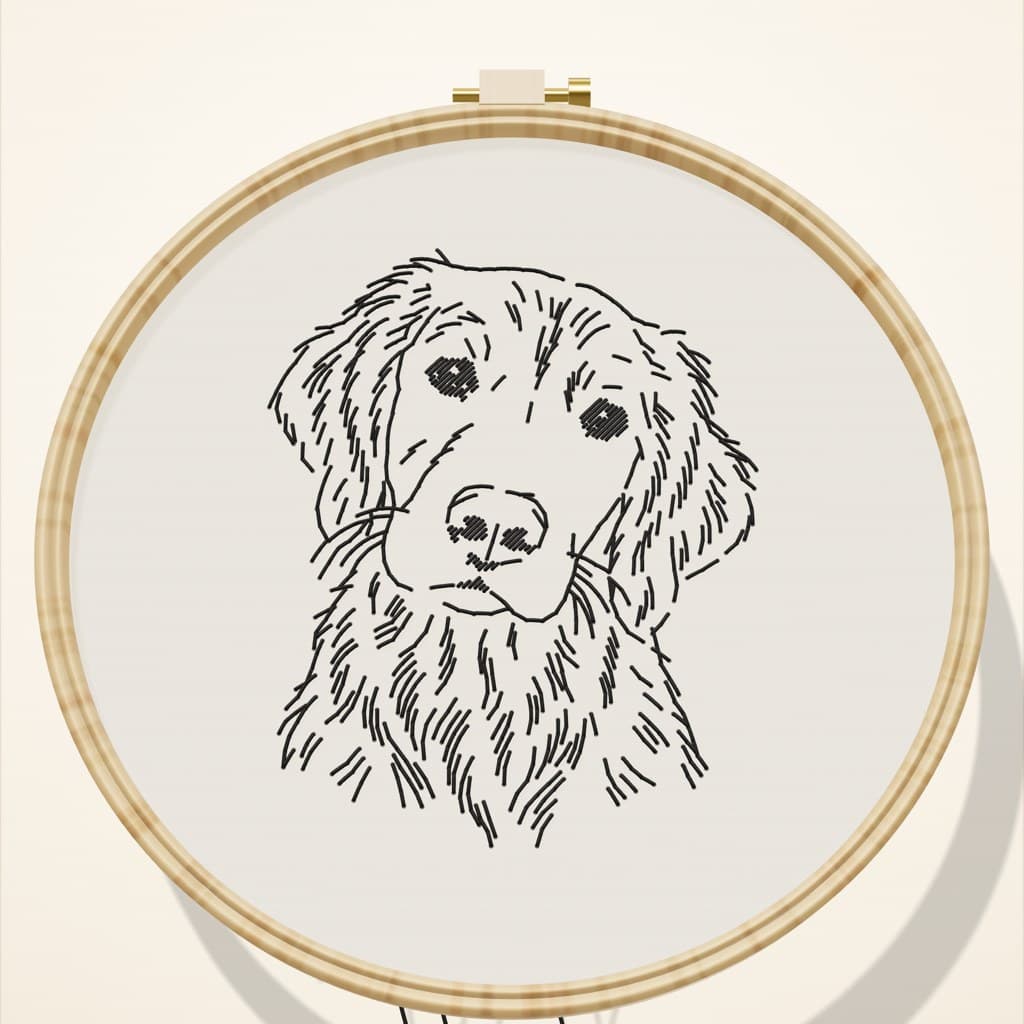
None of our three sample dogs is fluffy (Maple, the golden retriever, has a feathered coat, which sits in between), so there's no fluffy pattern on this page. For real patterns of softer coats, see the breed pages: a Cavalier's long, wavy ears, a Bernese mountain dog's thick coat and a schnauzer's bushy brows and beard. The method builds on how to embroider fur, pushed further.
Fluffy, curly, wavy or long: what to stitch
How to draw the edge of each kind of soft coat
| Coat | For example | The outline | The strokes |
|---|---|---|---|
| Fluffy and straight | Pomeranian, Samoyed, Chow Chow | Broken into short strokes that point outward | Fan them out from the body, longest at the ruff |
| Curly | Poodle, Bichon Frise | A bumpy edge made of small arcs | Small C-shaped strokes in loose clusters, with linen between them |
| Wavy | Most doodles | Soft and uneven | Loose C and S shapes, with a few longer waves on the ears |
| Long and silky | Shih Tzu, Havanese | Long lines falling from the top of the head | Gentle curves that hang down, with the eyes peeking through |
Doodles vary more than any other group. Look at your own dog's coat in the photo and pick the row it's closest to, not the one its breed name suggests.
How to stitch a fluffy dog, step by step
- Find the firm parts. In the photo, find the eyes, the nose and the mouth. They're the anchors. Everything soft gets placed around them.
- Start with the nose. Fill it with satin stitch, leaving its shine bare. On a fluffy dog it's often the darkest, clearest shape, so it sets the scale for the rest.
- Then the eyes. Stitch the part of each eye you can actually see: a rim where the fur parts, the pupil, the bare highlight. If fur covers the top of the eye, let it.
- Break the outline. Along the silhouette, stitch short strokes that start inside the dog and point outward, root to tip. Keep a solid line only where the shape is firm, like the top of the muzzle.
- Cluster, don't fringe. Group a few strokes together, then leave a small gap before the next group. Fluff reads as tufts. An even row of strokes reads as a fringe, or a hedgehog.
- Curls as little Cs. For curly coats, make each curl a small C of two or three stitches, turned a different way each time, with bare linen around it. For very tight curls, a cluster of French knots is an optional extra.
- Leave the inside bare. Inside the coat, stitch only where it parts: the line between the head and the ruff, and the edges of the ears. Bare linen reads as fluff.
- Squint and stop. Prop the hoop up across the room. If the face reads clearly and the coat looks soft, you're done.
Free · 3D Stitch Simulator
Try straight stitch on a 3D hoop
Watch the first stitches, then tap where your needle goes. Turn the hoop, zoom in, and flip it over to check the back.
Each fluff stroke is a short straight or back stitch. Try a few on the 3D hoop, then flip it: the thread on the back should stay short.
Want real texture later, once your line portraits come out even? Three optional stitches add it, none of them part of the course's flat line art: turkey work for a soft, trimmed ruff, bullion knots for tight curls, and French or colonial knots, packed close, for a tightly curled coat (which knot to use). Try one small patch first.
Finding the face in all that fluff
- Pick a photo taken soon after a trim, or brush the fur away from the eyes first. Any pattern, traced or drawn by a pattern maker, can only show what the photo shows.
- Have them look slightly up, toward a treat held above the camera. More light reaches eyes that sit deep in fur.
- Skip what you can't see. On many fluffy dogs the mouth is hidden. Leave it out: the eyes and nose carry the expression on their own.
- Draw the ears with falling strokes, not a closed shape. On a fluffy dog the ears blend into the head, and a few longer strokes hanging down show where they are.
When it doesn't look fluffy
- The dog looks shaved.
- The outline is too solid. Unpick a few stitches here and there along the edge and replace them with short outward strokes.
- It looks spiky, like a hedgehog.
- The strokes are too long and too even. Keep them short, vary their length, and group them with gaps between.
- The face got lost.
- Too many strokes crowd the eyes. Unpick the ones nearest each eye and leave a small ring of bare linen around it.
- The curls look like wallpaper.
- Every C is the same size and faces the same way. Turn them, and make a few smaller.
- Grey shadows between the tufts.
- Thread is jumping across bare linen between clusters on the back. Travel under nearby stitches, or end off and start again.
Questions people ask
How do you show fluffy fur with lines?
Break the outline into short strokes that point outward from the body, cluster them along the edge with small gaps between, and leave the inside of the coat as bare linen.
How do you embroider curly fur?
Make each curl a small C-shaped stroke of two or three stitches, turned different ways, in loose clusters with linen between them. French knots are an optional extra for very tight curls.
How do you embroider a doodle?
Look at the coat in your photo rather than the breed name: wavy coats get loose C and S strokes, curly coats get small Cs. Keep the eyes and nose clear and crisp.
Should I fill in a fluffy coat?
No. Filling hides the softness and takes many hours. Bare linen inside a broken outline reads as fluff better than any fill.
What if I can't see my dog's eyes in the photo?
Brush the fur away from the eyes, or use a photo taken soon after a trim, with the dog looking slightly up. Stitch only the part of each eye you can see.
Sources: Royal School of Needlework Stitch Bank: Straight stitch · Royal School of Needlework Stitch Bank: French knot · Needle 'n Thread: Starting and traveling threads