
Dog breed
Bernese mountain dog embroidery pattern: stitch your own Berner from a photo
To embroider a Bernese mountain dog, back stitch the head and ears, then the edges of the white blaze and the rounded rust spots above each eye, the breed's landmarks. Keep the black coat as an outline and a few fur lines, never a fill. Use 2 strands of black floss on oatmeal linen in a 6-inch hoop.
- Coat Long and thick, tricolor: black, rust and white
- Ears Triangular ears that hang close to the head
- Look for White blaze, rust spots over the eyes, white chest
- Line-art fit good
The real pattern: Otis, our sample Berner
Our pattern maker made this from a photo of Otis, a tricolor Bernese mountain dog and one of the sample dogs we use to test it. The photo is an AI-made sample image. The drawing, the dots and the stitched preview are the pattern maker's real output.
 1 The photoA sample photo (AI-made)
 2 The drawingClean line art, made by the pattern maker
- 3 The patternA dot at every needle hole, about 1/8 inch apart
- 4 StitchedA preview drawn from the pattern, in a 6-inch hoop
- Back stitches
- 653
- Satin fills
- 7 (eyes, nose and any small dark marks)
- Design size
- 3.8 × 4.7 in
- Thread
- 2 strands of black
- Rough stitching time
- 3–5 hours
Find the small rounded outlines above Otis' eyes: those are his rust eyebrow spots, drawn as edges. With the lines of the white blaze down the middle of the face, they say Berner even in one color of thread. The black coat is just its outline and the longer fur lines.
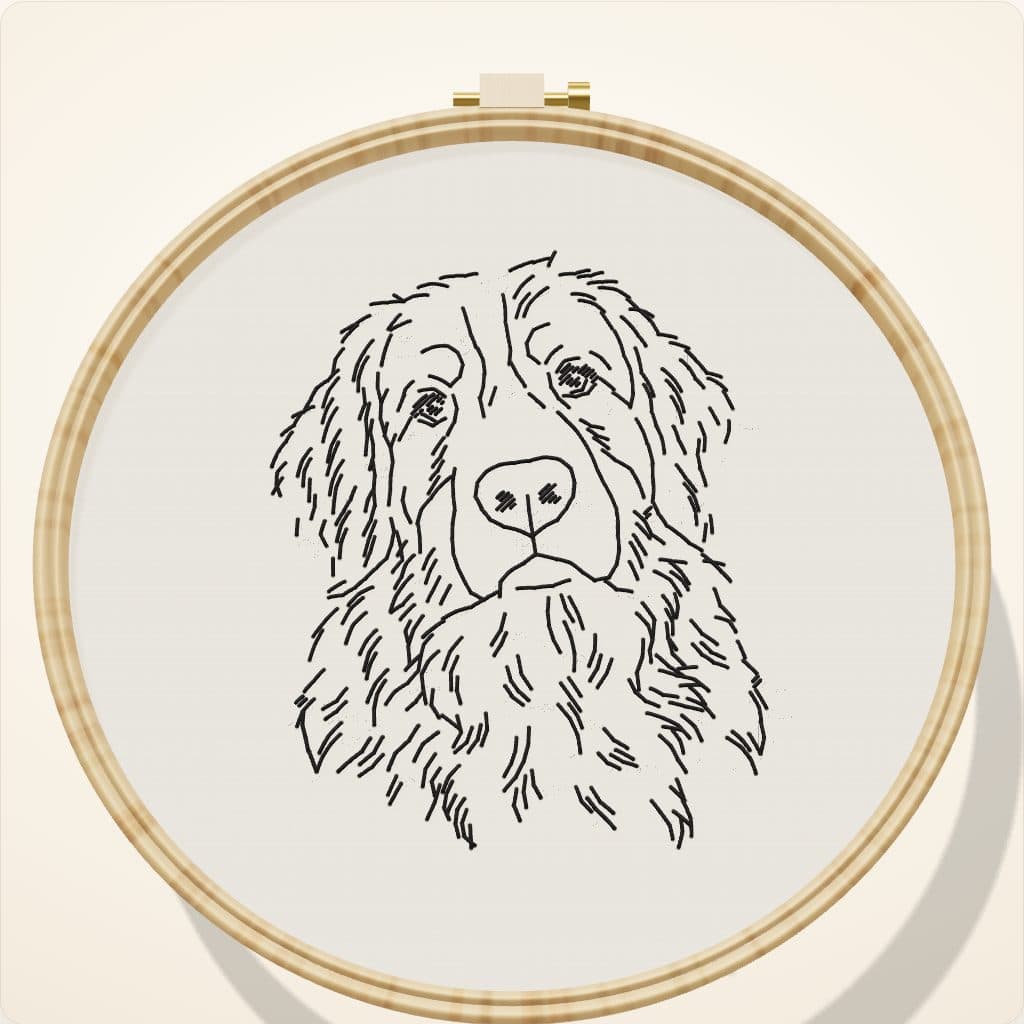
What makes a Berner look like a Berner in thread
The Bernese standard describes a tricolor dog: a jet-black ground with rich rust and clear white markings. Rust appears over each eye and on the cheeks, there's a white blaze and muzzle band, and the white on the chest often forms an upside-down cross. The ears are medium-sized, triangular and hang close to the head. In black thread the color is gone, so you stitch where the colors meet.
- The rust spots over the eyes. Stitch each one as a small rounded outline above the eye. They're tiny, and they're the most Berner thing on the face.
- The blaze and muzzle band. Lines down the middle of the forehead, opening out around the muzzle. Leave the white bare.
- The black coat is an outline. Stitch the outer edge of the head and ears and a few long fur lines on the chest. Never fill the black. Want more texture later? A small patch of turkey work on the thick fur of the neck gives a soft, raised ruff. It's an extra, not part of the pattern.
- The chest cross. If your photo shows it, a few lines where the white chest meets the black are enough.
Getting a good photo of your Berner
- Shoot close, by a big window or outdoors in open shade, with even light across the face. A Berner's black head hides its own edges in dim light.
- Wait for a catchlight in each eye. Dark eyes in a black face need it to show.
- A closed mouth is easier. A big Berner smile adds a tongue and lots of extra lines.
- We learned this one ourselves. Our first sample photo, taken outdoors with the mouth open, gave a pattern with small, stray satin spots along the black coat. A closer photo by a window, mouth closed, gave Otis' cleaner one.
If the pattern maker turns your photo away, it's usually too dark: try your brightest one. More in black and very dark dogs and how to choose a photo for a pet portrait. The same goes double for a Berner puppy, and the new puppy gift page has tips for a sharp puppy photo.
Stitching order for a Bernese mountain dog
- Head and ears. Back stitch the outline of the head and the two triangular ears.
- The landmarks. Stitch the rounded rust spots above the eyes and the lines of the blaze, before any fur.
- Eyes and nose. Satin stitch the pupils from the middle out with the highlight left bare, then fill the nose around the nostrils.
- Muzzle and chest. Stitch the muzzle band, the mouth line and the edge of the white chest.
- Fur lines, then stop. Add the longest fur lines on the ears and chest, root to tip, and stop while the coat still looks soft.
Common Bernese mistakes
- It reads as a different black dog.
- The rust spots or the blaze got left out. They're the landmarks: stitch them before the fur.
- The coat looks heavy.
- Too many fur lines. Keep the longest strokes and let the linen show between them.
- The brow spots look like extra eyes.
- They were stitched too big or too dark. Keep each one a small, light outline, well above the eye.
Questions people ask
Can I turn a photo of my Bernese Mountain Dog into an embroidery pattern?
Yes. The Stitch Your Dog course turns a photo of your own Berner into a pattern with a dot at every stitch, the way it made Otis' here. Berners are dark, so the photo matters more than for most dogs: close, evenly lit, with a catchlight in each eye.
What stitches work best for a Bernese Mountain Dog?
Back stitch for the outline, the rust spots, the blaze and the fur lines, and satin stitch for the eyes and nose. Both are beginner stitches, and they're the two the course teaches.
How do I show a Bernese Mountain Dog's tricolor face in thread?
Stitch where the colors meet: lines for the white blaze down the face, a small rounded outline for each rust spot above the eyes, and a line around the white muzzle. Leave the black as bare linen inside its outline. That's enough to say Berner in one color.
How long does a Bernese Mountain Dog portrait take to stitch?
Otis' pattern has 731 stitches in all: 653 backstitches and 78 small satin stitches. At an easy beginner pace of 2.5 to 4 stitches a minute, that's roughly 3 to 5 hours, over a few evenings.
Sources: Stitch Your Dog pattern maker: its photo checks and its real output on our sample dogs (1 Nov 2026) · American Kennel Club: the official Bernese Mountain Dog breed standard · Royal School of Needlework Stitch Bank: Back stitch · Royal School of Needlework Stitch Bank: Satin stitch