Dog breed
Cavalier King Charles spaniel embroidery pattern: stitch your own Cavalier from a photo
To embroider a Cavalier King Charles spaniel, satin stitch the big, round eyes first and leave a clear highlight in each, because the soft expression is the breed. Then back stitch the face, the blaze and the long feathered ears as loose, wavy lines. Use 2 strands of black floss on oatmeal linen in a 6-inch hoop.
- Coat Silky: Blenheim, tricolor, ruby, or black and tan
- Ears Long, feathered ears set high
- Look for Big round eyes, soft expression, white blaze
- Line-art fit good
The real pattern: Rosie, our sample Cavalier
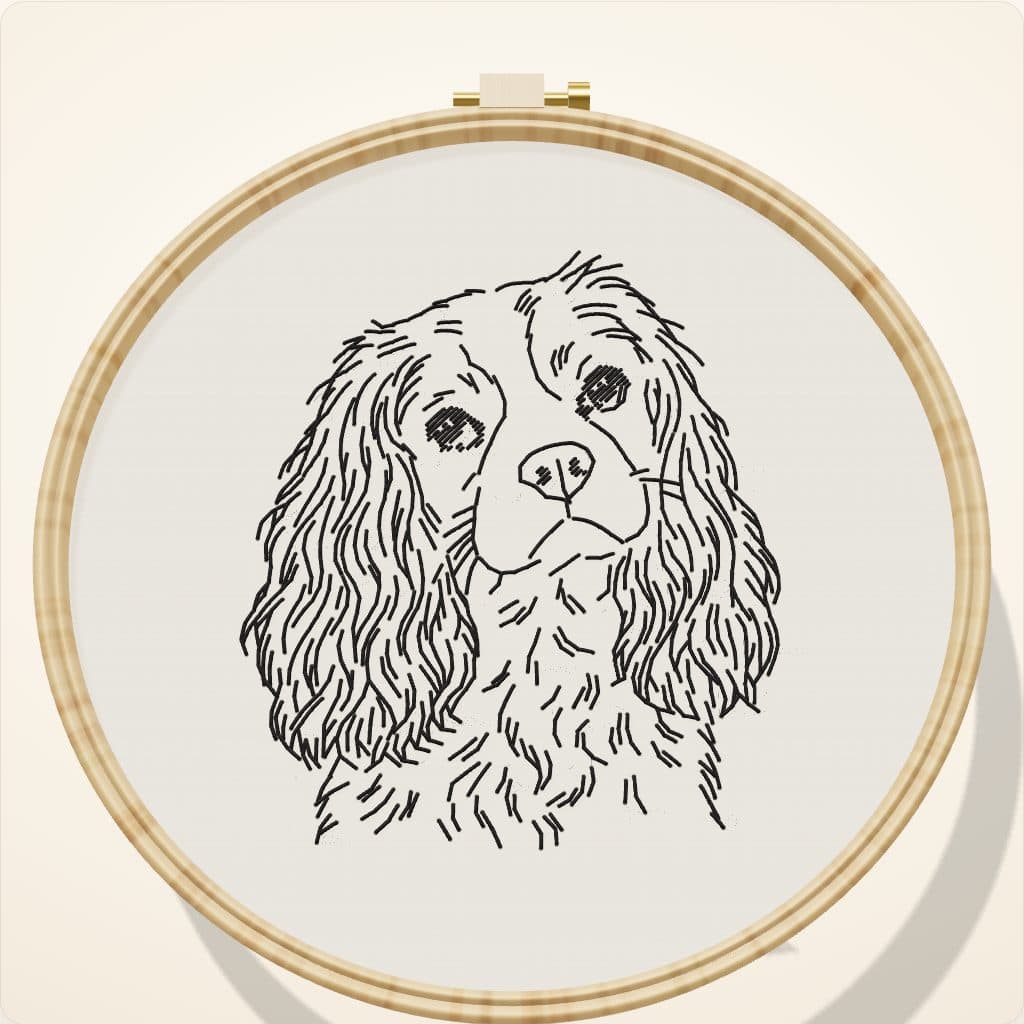
Our pattern maker made this from a photo of Rosie, a Blenheim (chestnut and white) Cavalier and one of the sample dogs we use to test it. The photo is an AI-made sample image. Everything after it is the pattern maker's real output.
 1 The photoA sample photo (AI-made)
 2 The drawingClean line art, made by the pattern maker
- 3 The patternA dot at every needle hole, about 1/8 inch apart
- 4 StitchedA preview drawn from the pattern, in a 6-inch hoop
- Back stitches
- 1000
- Satin fills
- 5 (eyes, nose and any small dark marks)
- Design size
- 4.0 × 4.7 in
- Thread
- 2 strands of black
- Rough stitching time
- 4½–7 hours
Rosie's ears are full of long, wavy lines, which makes this the busiest pattern on our breed pages. The pattern maker needed two tries at the drawing to get one that passed its own checks. Her face is simple by comparison: two big satin eyes, the nose and the edges of the blaze.
What makes a Cavalier look like a Cavalier in thread
The Cavalier standard asks for large, round, very dark eyes with a sweet, gentle, melting expression, and long ears with plenty of feathering that frame the face. Blenheims and tricolors have a white blaze between the eyes. In black thread, the eyes and the frame of the ears are the whole likeness.
- Eyes first, and big. Satin stitch each eye from the middle out and leave a generous highlight. Don't shrink them. A Cavalier's eyes really are that large.
- Ears are wavy outlines. Stitch the outer edge of each ear as one loose, wavy line, then the longest waves inside. You don't need every curl. Want more texture later? A few bullion knots along the longest waves add real curl. They're an extra, not part of the pattern.
- The blaze centers the face. Two lines up the forehead, where the white meets the chestnut or black.
- Keep the muzzle short. A short nose, a small mouth line and a little cushion under each eye.
Long feathering makes a long pattern. If yours looks busy, stitch the Simple version the course gives you: it keeps the face and only the longest ear lines. Or stop on the ears as soon as they read as feathered. For a quick gift, a 3-inch ornament keeps the big eyes, the nose and the outline of the ears, and leaves most of the waves out.
Getting a good photo of your Cavalier
- Get both eyes sharp and both ears in the frame. A Cavalier's ears hang down to the chest, so leave room.
- Brush the ears first. Tangled feathering becomes lots of little lines.
- Use soft daylight. Bright sun on a white blaze washes out its edges.
- Ruby and black-and-tan Cavaliers are darker all over. Shoot by a big window or outdoors in open shade, so the eyes and the edges of the ears show.
Stitching order for a Cavalier King Charles spaniel
- Eyes first. Satin stitch both eyes from the middle out, leaving a round highlight in each. Everything else is built around them.
- Face and blaze. Back stitch the outline of the face, the short muzzle and the two edges of the blaze.
- The nose. Fill the nose with satin stitch around the nostrils.
- Ear outlines. Stitch the outer edge of each ear as one loose, wavy line, top to bottom.
- Feathering, then stop. Add the longest waves inside the ears and a few fur lines on the chest. Stop as soon as the ears read as soft.
Common Cavalier mistakes
- The eyes look small and beady.
- The satin stopped short of the outline. Fill out to every edge and keep the highlight round.
- The ears are a dark tangle.
- Too many curl lines, too close together. Keep the outer edge and the longest waves, and let the linen show.
- The waves look choppy.
- Long stitches cut across the curves. Land on every dot so each wave stays round.
Questions people ask
Can I turn a photo of my Cavalier King Charles Spaniel into an embroidery pattern?
Yes. The Stitch Your Dog course turns a photo of your own Cavalier into a pattern with a dot at every stitch, the way it made Rosie's here. Brush the ears and use soft daylight, so the feathering doesn't turn into a tangle of lines.
What stitches work best for a Cavalier King Charles Spaniel?
Satin stitch for the big eyes and the nose, and back stitch for the face, the blaze and the wavy ear lines. Those are the two beginner stitches the course teaches.
How do I show a Cavalier King Charles Spaniel's big round eyes in thread?
Satin stitch each eye from the middle out to its round edge, keeping every stitch parallel, and leave a clear highlight bare near the top. Big, dark, round eyes with a highlight give the soft Cavalier look, so don't make them smaller.
How long does a Cavalier King Charles Spaniel portrait take to stitch?
Rosie's pattern is a big one: 1,085 stitches, 1,000 backstitches and 85 small satin stitches, most of them in the ears. At an easy beginner pace of 2.5 to 4 stitches a minute, that's roughly 4.5 to 7 hours. The Simple version is much quicker.
Sources: Stitch Your Dog pattern maker: its photo checks and its real output on our sample dogs (1 Nov 2026) · American Kennel Club: the official Cavalier King Charles Spaniel breed standard · Royal School of Needlework Stitch Bank: Satin stitch · Needle 'n Thread: 10 tips for a sensational satin stitch