
Stitch guide · Fills
How to do a satin stitch
Satin stitch fills a small shape with straight stitches laid side by side, edge to edge, all in the same direction. Done well, it looks smooth and solid. Use it for small shapes like eyes, noses, leaves and letters. For larger areas, the long stitches can loosen and snag, so long and short stitch is better.
- Level Easy
- Practice Free in the 3D simulator
Use it in a pet portrait for…
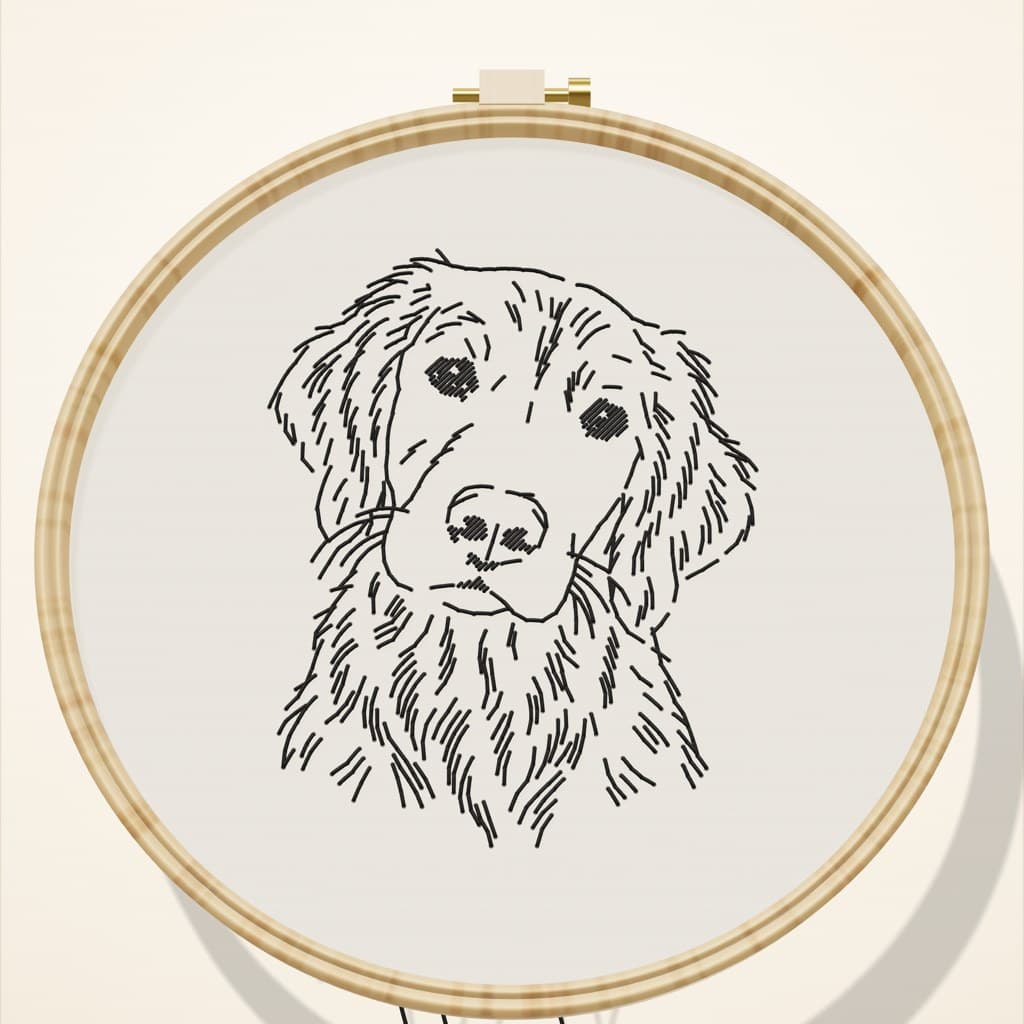
- Your dog's eyes, with a tiny bare spot of fabric left as the highlight that makes them shine.
- The nose, filled solid.
- A collar tag, a heart or a tiny ball.
Satin stitch is one of the two core stitches in the Stitch Your Dog course, along with back stitch. It's how you fill the eyes and nose.
How to do it, step by step
Start in the middle: up at 1, straight across and down at 2. Come up at 3 right beside the first stitch, and down at 4. Work out to the edge, then go back to the middle and fill the other half. (The stitches are spread out here so you can see each hole; on fabric they touch.)
1 Odd numbers: come up from the back2 Even numbers: go down Dashed: the next stitch
- Optional: outline the shape with a tiny split stitch first, for a crisp edge.
- Start in the middle of the shape, not at one end. Come up on one edge.
- Go straight across and down on the opposite edge (just outside the split-stitch edge, if you made one).
- Come up on the first edge again, right beside your first stitch. Stitches should touch, not overlap.
- Work out to one end of the shape. Then go back to the middle and fill the other half the same way.
- Keep every stitch parallel. If the shape has a highlight, stop at its edge, leave it bare and carry on past it.
Free · 3D Stitch Simulator
Try satin stitch on a 3D hoop
Watch the first stitches, then tap where your needle goes. Turn the hoop, zoom in, and flip it over to check the back.
Common mistakes and how to fix them
- Fabric peeking through.
- Place each stitch right against the last one, and use fresh thread with the strands lying flat, not twisted.
- Stitches drift to a slant.
- Start in the middle and work out to each side. It keeps the angle the same all the way across.
- Ragged edges.
- Come up and go down exactly on the line, or outline the shape with split stitch first.
- Tiny circles that bulge.
- On small round shapes, stop a hair inside the line instead of going right to the edge.
- Loose stitches that catch.
- Satin is for small shapes. If the stitches get long, switch to long and short stitch.
How many strands?
Two strands is the standard, and it fills quickly. One strand takes longer but gives the smoothest, glossiest finish. Either way, start with a fresh, shorter length of floss so it doesn't get fuzzy.
Embroidery floss comes as six thin strands twisted together. Cut a length from your fingertips to your elbow, pull out the strands you need one at a time, and lay them back together (DMC’s guide to stranded floss).
Questions people ask
Do I need to outline before satin stitch?
No, it's optional. A split-stitch outline gives a crisper edge, but on small shapes plain satin stitch works fine.
Why does my satin stitch look gappy?
Usually the stitches are a little too far apart, or the strands have twisted. Lay each stitch right beside the last, and let the needle dangle now and then to untwist the thread.
Where should I start satin stitch?
In the middle of the shape. Fill out to one side, then go back to the middle and fill the other side, so every stitch keeps the same angle.
How do I leave a highlight in a stitched eye?
Stop your stitches at the edge of the highlight and pick up again on the other side, leaving that spot bare. Don't carry dark thread behind it on the back, or it will show through.
How big can a satin-stitched shape be?
Keep it small. Long satin stitches can sag and catch. For bigger areas, use long and short stitch.
Sources: Royal School of Needlework Stitch Bank: Satin stitch · Needle 'n Thread: 10 tips for a sensational satin stitch