
How-to guide
How to embroider eyes for a pet portrait
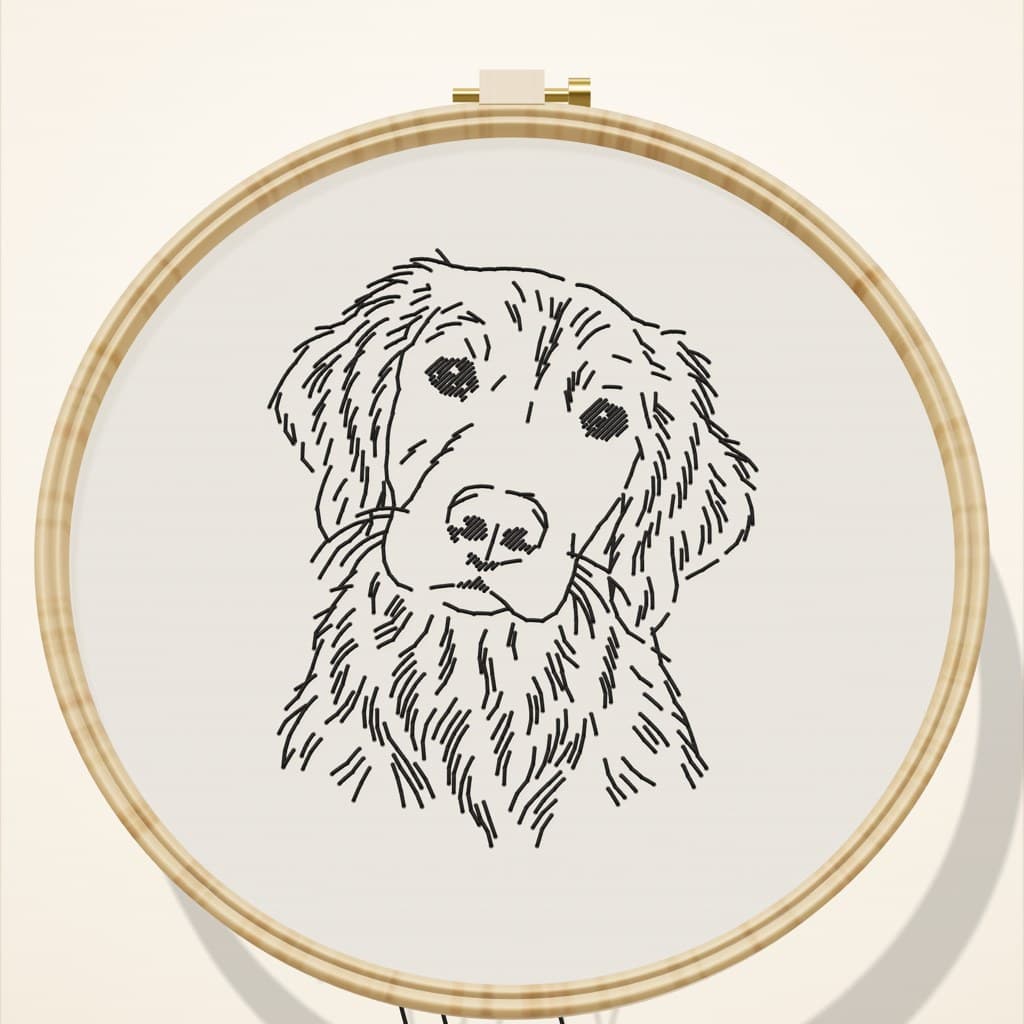
To embroider eyes in a pet portrait, fill each pupil with satin stitch using 2 strands of black floss. Start in the middle and work out to one side, then back to the middle and out to the other. Leave the small highlight bare, and come up just inside the outline so the eye stays round.
Why the eyes matter most
People look at the eyes first. In a line-art portrait the pupils are usually the only solid black shapes, so they carry the expression. The highlight, a tiny bare spot of linen inside each pupil, is what makes them look wet and alive. Skip it and the eyes look flat.
A pet portrait's eye usually has two parts: a back-stitched outline of the eye shape, and a satin-stitched pupil inside it. This guide is about the pupil.
How to satin stitch an eye, step by step
- Use fresh, short thread. Cut about 12 inches of black floss and take 2 strands. Satin shows every bit of fuzz, so start each eye with a new length.
- Optional: edge it first. For an extra-crisp edge, outline the pupil with tiny split stitches. Plain satin works fine without it.
- Start in the middle. Bring the needle up just inside the line at the widest part of the pupil, and go down just inside the opposite edge. That first stitch sets the angle.
- Work out to one side. Lay each stitch right beside the last one, parallel and touching, until you reach the end of the shape.
- Go around the highlight. Stop each stitch at the edge of the highlight and leave it bare. Fill along one side of it, then come back along the other side, so no black thread runs behind the bare spot on the back.
- Fill the other half. Slide under the stitches on the back to return to the middle, and fill the other side the same way.
- Finish under the satin. Slide the needle under 4 or 5 stitches on the back and trim close.
Do both eyes in one sitting, with the same thread and the same stitch angle. Matching eyes matter more than perfect ones.
Practice an eye on a 3D hoop
The free simulator has a lesson for exactly this: an eye with a highlight. It makes the first stitches from the middle out, then hands you the needle. Flip the hoop to check that nothing runs behind the highlight.
Free · 3D Stitch Simulator
Try satin stitch on a 3D hoop
Watch the first stitches, then tap where your needle goes. Turn the hoop, zoom in, and flip it over to check the back.
Satin stitch or French knot?
Satin stitch vs French knot for eyes
| Satin stitch | French knot | |
|---|---|---|
| Best for | Pupils of almost any size in a portrait | Tiny eyes, smaller than about 1/8 inch |
| Look | A smooth, solid shape with a bare highlight | A small raised dot |
| Highlight | Easy to leave bare | No room for one |
| For a beginner | Easy with the middle-out method | Takes practice to keep the knot neat |
In a dog portrait sized for a 6-inch hoop, the pupils are big enough for satin. Save the French knot for a tiny animal in a bigger scene.
Common eye mistakes
- The eye looks square or bulgy.
- Satin that goes all the way to the line tends to bulge. Come up and go down a hair inside the line.
- Stitches slant every which way.
- Start in the middle and keep every stitch parallel to that first one.
- Linen shows between stitches.
- Lay each stitch right against the last. Fill a gap with one more stitch rather than a second layer on top.
- A grey shadow behind the highlight.
- Thread crossed behind the bare spot on the back. Unpick it and travel around the highlight instead.
- Fuzzy, dull satin.
- The thread was worn. Unpick the eye and redo it with a fresh 12-inch length.
Light or pale eyes
In black thread you stitch the pupil, not the eye color. For a dog with pale blue or amber eyes, the pupil is still the dark center. Keep it a little smaller and let the bare linen around it read as the light iris, with the back-stitched outline holding the shape. Very pale eyes can confuse any drawing made from a photo, ours included, so check the eyes on your pattern against the photo before you stitch them.
Questions people ask
Where does the white highlight go?
Toward the top of the pupil, on the same side in both eyes, matching where the light falls in your photo. Leave it as bare fabric instead of stitching it white.
Satin stitch or French knot for small eyes?
Satin stitch for any pupil you can draw as a shape, which covers most pet portraits. A French knot only for eyes smaller than about 1/8 inch.
How do you embroider dog eyes?
Back stitch the outline of the eye, then fill the pupil with satin stitch from the middle out, leaving a small highlight bare. Use 2 strands of black floss.
How do you embroider realistic eyes?
Realism comes from the highlight and the shape, not extra colors. Keep the pupil round, leave the highlight bare, and match its position in both eyes.
How do you embroider cat eyes?
The same way, with a round or slit-shaped pupil, depending on the light in your photo. Our pattern maker does dogs only for now, and cats are next.
Sources: Needle 'n Thread: 10 tips for a sensational satin stitch · Needle 'n Thread: Some notes on satin stitch · Royal School of Needlework Stitch Bank: Satin stitch