
Dog breed
Corgi embroidery pattern: stitch your own corgi from a photo
To embroider a corgi, back stitch the upright, pointed ears first, then the fox-shaped face and the edge of the white blaze. Satin stitch the eyes and nose, add a few whiskers and fur lines, and stop. It's the quickest pattern on our breed pages. Use 2 strands of black floss on oatmeal linen in a 6-inch hoop.
- Coat Medium double coat: red, sable, fawn, or black and tan, often with white
- Ears Erect ears tapering to a rounded point
- Look for Upright ears, fox face, white blaze
- Line-art fit great
The real pattern: Waffles, our sample corgi
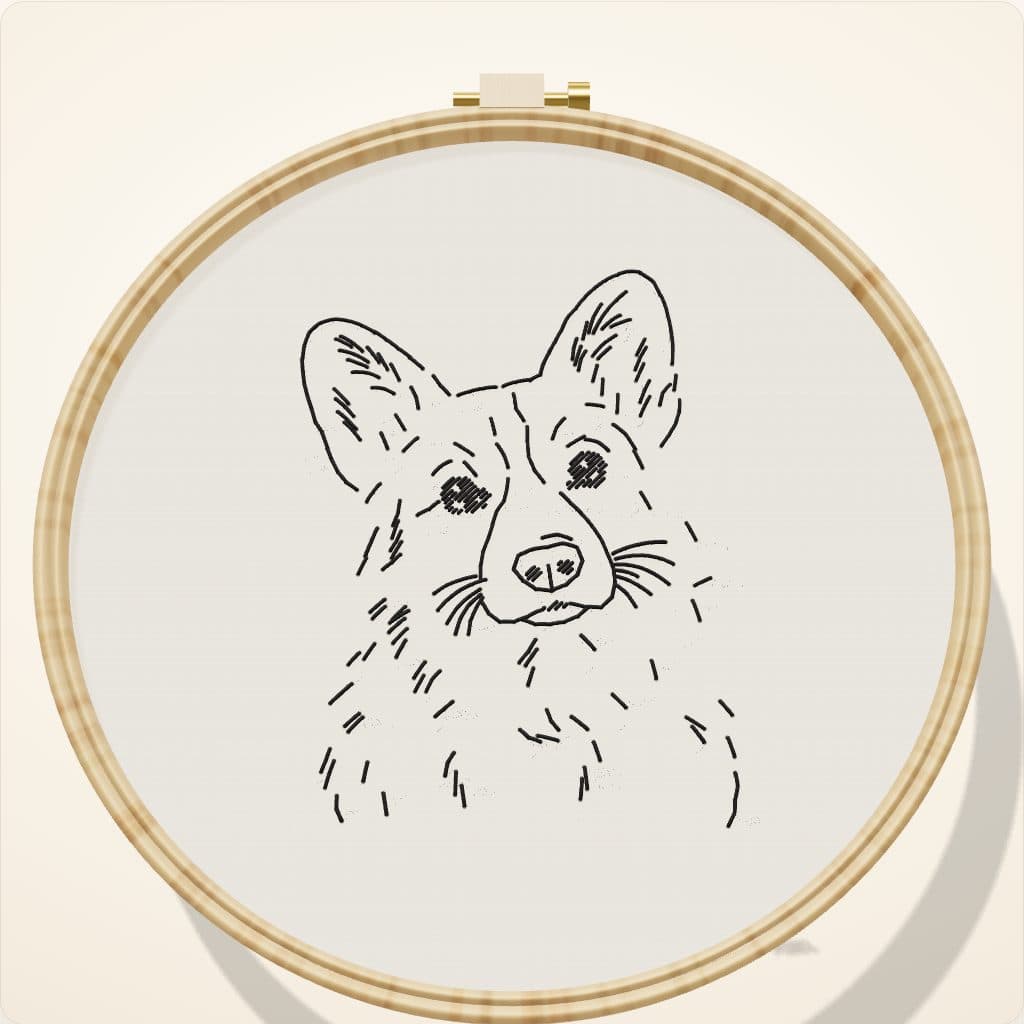
Our pattern maker made this from a photo of Waffles, a red-and-white Pembroke Welsh corgi and one of the sample dogs we use to test it. The photo is an AI-made sample image. The drawing, the dots and the stitched preview are its real output.
 1 The photoA sample photo (AI-made)
 2 The drawingClean line art, made by the pattern maker
- 3 The patternA dot at every needle hole, about 1/8 inch apart
- 4 StitchedA preview drawn from the pattern, in a 6-inch hoop
- Back stitches
- 286
- Satin fills
- 5 (eyes, nose and any small dark marks)
- Design size
- 3.3 × 4.4 in
- Thread
- 2 strands of black
- Rough stitching time
- 1½–2½ hours
This is the shortest pattern on our breed pages. The ears, one line for the edge of the blaze, the eyes, the nose and a few whiskers say corgi straight away. Our pattern maker draws the head and the top of the chest, which gives those ears room in a 6-inch hoop. A face this simple also makes a good 3-inch tree ornament.
What makes a corgi look like a corgi in thread
The Pembroke standard calls for a foxy head, erect ears that taper to a slightly rounded point, and a coat of red, sable, fawn, or black and tan, with or without white on the muzzle, chest and a narrow blaze. The standard says the ears are medium-sized, but on that small fox face they look enormous, and that's the likeness.
- The ears carry it. Stitch each one from the wide base up to the point and back down. Add three or four fur lines inside, fanning out from the base.
- A fox face. The muzzle tapers to a small nose. Keep the line from each cheek to the nose smooth and unbroken.
- One line for the blaze. Where the white runs up the forehead, a single clean line is enough.
- A few whiskers. Short, light strokes from the muzzle, two or three on each side.
A Cardigan Welsh corgi, the one with the long tail, has big upright ears too. Stitch it the same way.
Getting a good photo of your corgi
- Get the ears up and in the frame, tips included. Say your corgi's name, or crinkle a treat bag.
- Shoot at eye level. Corgis are low, so sit on the floor.
- Use soft daylight, so the white blaze and chest keep their edges.
- One dog per photo, with both eyes sharp.
Stitching order for a corgi
- Ears first. Back stitch both ears from the base to the point and back, then the top of the head between them.
- Face and blaze. Stitch the cheeks, the tapering muzzle and the line of the blaze.
- Eyes and nose. Satin stitch the pupils from the middle out, leaving the highlight bare, then fill the nose.
- Whiskers and ear fur. Add the short whisker strokes and the fur lines inside each ear.
- Chest, then stop. Stitch the few fur lines on the chest, root to tip. That's it: a corgi is a short stitch.
Common corgi mistakes
- The ears look like rabbit ears.
- They got too narrow. Each ear is wide at the base. Follow the base dots all the way out before you turn up.
- The face looks round.
- The muzzle lost its taper. Re-stitch the cheek lines dot to dot, so they run straight in to the nose.
Questions people ask
Can I turn a photo of my Pembroke Welsh Corgi into an embroidery pattern?
Yes. The Stitch Your Dog course turns a photo of your own corgi into a pattern with a dot at every stitch, the way it made Waffles' here. Get the ears up and in the frame, and shoot at your corgi's eye level.
What stitches work best for a Pembroke Welsh Corgi?
Back stitch for the ears, the outline, the blaze, the whiskers and the fur lines, and satin stitch for the eyes and nose. Both are beginner stitches, and they're the two the course teaches.
How do I show a Pembroke Welsh Corgi's big ears in thread?
Outline each ear from the wide base up to its slightly rounded point and back down, landing on every dot at the tip. Then add three or four short fur lines inside, fanning out from the base. Big, upright ears are the corgi.
How long does a Pembroke Welsh Corgi portrait take to stitch?
The corgi pattern on this page has 362 stitches in all: 286 backstitches and 76 small satin stitches. At an easy beginner pace of 2.5 to 4 stitches a minute, that's roughly 1.5 to 2.5 hours, an evening or two.
Is there a free corgi embroidery pattern?
The pattern on this page is a sample to look at. The course makes one from a photo of your own corgi, which is the one that will actually look like your dog.
Sources: Stitch Your Dog pattern maker: its photo checks and its real output on our sample dogs (1 Nov 2026) · American Kennel Club: the official Pembroke Welsh Corgi breed standard · Royal School of Needlework Stitch Bank: Back stitch · Royal School of Needlework Stitch Bank: Satin stitch