
Dog breed
German shepherd embroidery pattern: stitch your own GSD from a photo
To embroider a German shepherd, back stitch the tall erect ears and the long, wedge-shaped muzzle first, because they carry the likeness. Mark where the dark mask meets the tan with a few short lines, not a fill, then satin stitch the eyes and nose. Use 2 strands of black floss on oatmeal linen in a 6-inch hoop.
- Coat Medium double coat, most often black and tan
- Ears Large, pointed ears carried erect
- Look for Erect ears, long wedge-shaped muzzle, saddle and mask
- Line-art fit great
The real pattern: Koda, our sample German shepherd
Our pattern maker made this from a photo of Koda, a black-and-tan German shepherd and one of the sample dogs we use to test it. The photo is an AI-made sample image. Everything after it is the pattern maker's real output.
 1 The photoA sample photo (AI-made)
 2 The drawingClean line art, made by the pattern maker
- 3 The patternA dot at every needle hole, about 1/8 inch apart
- 4 StitchedA preview drawn from the pattern, in a 6-inch hoop
- Back stitches
- 417
- Satin fills
- 6 (eyes, nose and any small dark marks)
- Design size
- 3.0 × 4.7 in
- Thread
- 2 strands of black
- Rough stitching time
- 2–3½ hours
The ears and the muzzle are clean outlines, with short fur lines inside each ear. Where the dark mask meets the tan, the pattern uses a few broken lines, and it fills two small dark marks at the inner brows. It doesn't try to fill the mask or the saddle. In one color of thread, an edge says it better.
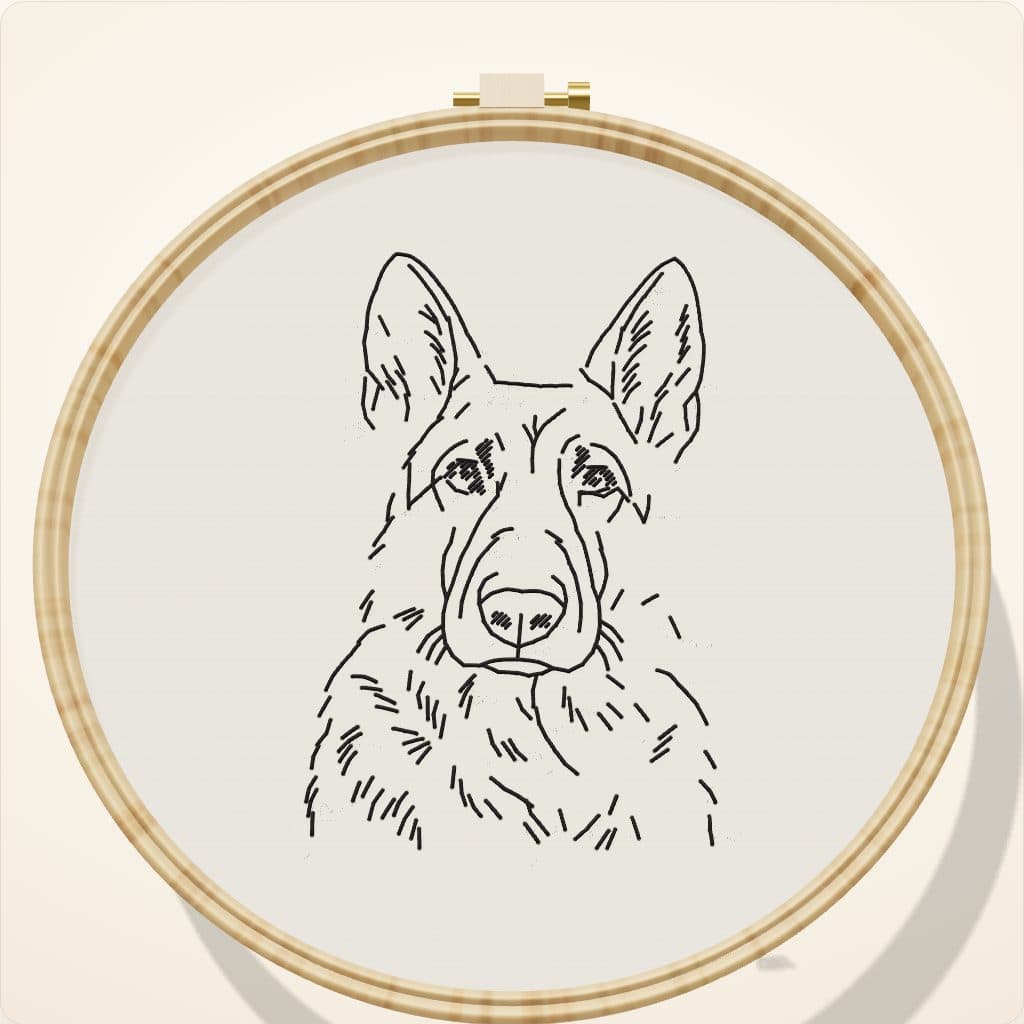
What makes a German shepherd look like one in thread
The breed standard asks for moderately pointed ears carried erect, a long, wedge-shaped muzzle and eyes as dark as possible. Most shepherds people picture are black and tan, with a dark saddle on the back and a dark mask on the face. A head-and-chest portrait shows the ears and the muzzle, and that's where the likeness lives. It's also why a shepherd suits a 3-inch ornament, which keeps the outline, the ears, the eyes and the nose and drops most of the fur.
- The ears are tall and open. Stitch each outline slowly and land on the exact dot at the tip. Then add three or four short fur lines inside each ear, following the way the hair grows.
- The muzzle is long. Keep the line down the bridge of the nose clean and unbroken from the brow to the nose. A short muzzle makes a shepherd look like a different dog.
- Markings are edges, not fills. Mark where the mask meets the tan with a short broken line. Don't satin stitch the mask or the saddle: it's slow, and in black thread it turns into a heavy blot.
- A thicker ruff. A few longer strokes down the neck and chest show the double coat.
Black and dark sable shepherds are stitched the same way. The difference is the photo, so read the photo tips below.
Getting a good photo of your German shepherd
- Catch the ears up. Make a small sound so your dog pricks them. Ears folded back change the whole shape of the head.
- Keep both ear tips in the frame, with a little space above them.
- Use bright, even light on the face. In shade a dark mask and saddle can merge into one dark mass, and the pattern maker can only draw edges it can see.
- Black or dark sable? Shoot outdoors in open shade on a bright day, or right next to a big window, so the edges of the face and the eyes show. If the pattern maker turns the photo away, try your brightest one.
More in how to choose a photo for a pet portrait and black and very dark dogs.
Stitching order for a German shepherd
- Ears first. Back stitch both ear outlines, base to tip and back, then the top of the head between them.
- The muzzle. Stitch the long line of the bridge, the edges of the muzzle and the jaw.
- Eyes and nose. Satin stitch the pupils from the middle out with the highlight left bare, then the nose. Fill the two small brow marks the same way.
- The mask edge. Add the short broken lines where the mask meets the tan.
- Ears and ruff, then stop. Finish with the fur lines inside the ears and down the chest, root to tip, and stop as soon as it reads as your dog.
Common German shepherd mistakes
- The ears look floppy.
- The tips got rounded off. Go down exactly in the tip dot, then turn.
- The face looks muddy.
- Too many mask lines. Keep them short and broken, and let the linen show between them.
- The muzzle looks short.
- The bridge line wandered or stopped early. Re-stitch it as one steady run, dot to dot.
Questions people ask
Can I turn a photo of my German Shepherd Dog into an embroidery pattern?
Yes. The Stitch Your Dog course turns a photo of your own shepherd into a pattern with a dot at every stitch, the way it made Koda's here. Ears up, both eyes sharp and bright, even light on the face give the best result.
What stitches work best for a German Shepherd Dog?
Back stitch for the outline, the ears, the mask edge and the fur lines, and satin stitch for the eyes and nose. Those are the two beginner stitches the course teaches.
How do I show a German Shepherd Dog's erect ears in thread?
Outline each ear with small, even back stitches, land exactly on the dot at the tip, and add a few short fur lines inside that follow the hair. Keep both tips sharp. The ears are most of the likeness.
How long does a German Shepherd Dog portrait take to stitch?
Koda's pattern has 517 stitches in all: 417 backstitches and 100 small satin stitches. At an easy beginner pace of 2.5 to 4 stitches a minute, that's roughly 2 to 3.5 hours, over a couple of evenings.
Is there a free German shepherd embroidery pattern?
The pattern on this page is a sample to look at. The course makes one from a photo of your own shepherd, which is the one that will actually look like your dog.
Sources: Stitch Your Dog pattern maker: its photo checks and its real output on our sample dogs (1 Nov 2026) · American Kennel Club: the official German Shepherd Dog breed standard · Royal School of Needlework Stitch Bank: Back stitch · Royal School of Needlework Stitch Bank: Satin stitch