Stitch guide · Outlines
How to do a back stitch
Back stitch is a hand embroidery stitch that makes a solid, unbroken line. Each new stitch goes backward to meet the end of the last one, sharing its hole. Use it for outlines, lettering and fine details. It's one of the first stitches beginners learn, and it follows curves well when you keep the stitches short.
- Level Beginner
- Also called Backstitch
- Practice Free in the 3D simulator
Use it in a pet portrait for…
- The outline of your dog: the head, the ears, the chin and the line of the back.
- Face lines, like the curve of the mouth and the edge of the nose.
- A few short fur lines that show which way the coat grows.
- Your dog's name, stitched under the portrait.
Back stitch is one of the two core stitches in the Stitch Your Dog course. Every dot on your pattern is one hole, so you stitch from dot to dot.
How to do it, step by step
Come up at 1 and go down at 2. Come up at 3, then go back down into the shared hole at 4. The dashed stitch, 5 to 6, is the next one.
1 Odd numbers: come up from the back2 Even numbers: go down Dashed: the next stitch
- Come up through the fabric one stitch length along your line, away from where the line starts.
- Go down at the very start of the line. That's your first stitch.
- Come up one stitch length ahead of the first stitch.
- Go down into the end of the first stitch, through the same hole. That shared hole is what makes the line look smooth.
- Repeat: come up one stitch ahead, then go down into the last hole. Keep every stitch the same length.
- To finish, take the needle to the back, slide it under the backs of a few stitches, and trim.
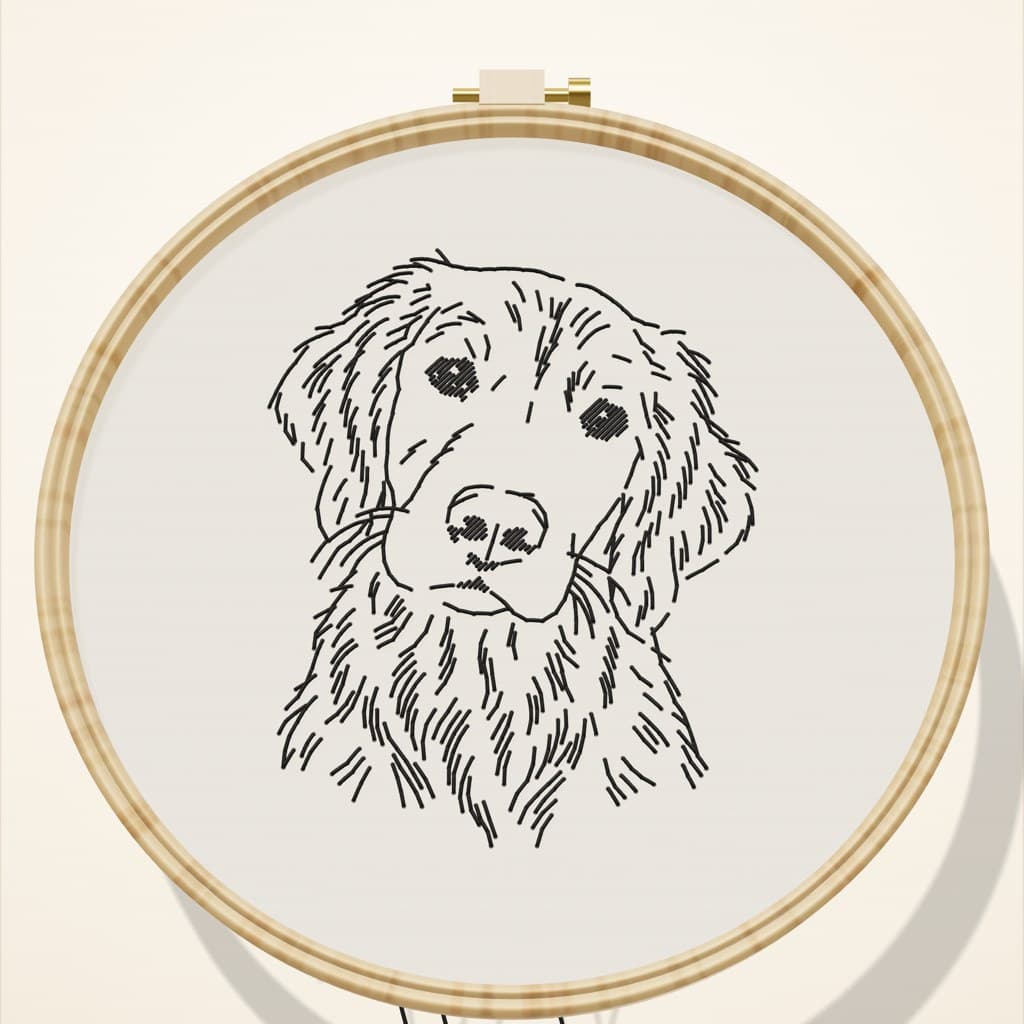
Free · 3D Stitch Simulator
Try back stitch on a 3D hoop
Watch the first stitches, then tap where your needle goes. Turn the hoop, zoom in, and flip it over to check the back.
Common mistakes and how to fix them
- Little gaps between stitches.
- Go down into the exact hole where the last stitch ended, not just beside it.
- Wobbly, slanted stitches.
- Stab the needle straight down and straight up, one motion at a time, instead of scooping through the fabric.
- Jagged curves.
- Make your stitches shorter as the curve gets tighter.
- Puckered fabric.
- Keep the fabric drum-tight in the hoop, and let the thread lie flat instead of pulling it tight.
How many strands?
Two strands of six-strand floss is a good everyday choice, and it's what we use for pet portraits. Use one strand for tiny details, or three for a bolder line.
Embroidery floss comes as six thin strands twisted together. Cut a length from your fingertips to your elbow, pull out the strands you need one at a time, and lay them back together (DMC’s guide to stranded floss).
Questions people ask
What's the difference between back stitch and running stitch?
Running stitch leaves a gap between stitches, like a dashed line. Back stitch fills each gap by going backward into the last hole, so the line looks solid.
How long should each back stitch be?
Short stitches follow curves best, so keep them small and even. Our patterns mark every stitch with a dot about 3 mm (1/8 inch) apart, and you stitch from dot to dot.
What should the back of back stitch look like?
On the back, each stitch is about twice as long and they overlap a little. That's exactly right. Just avoid long jumps across bare fabric, because dark thread shows through light linen.
Is it "backstitch" or "back stitch"?
Both spellings are used, and they mean the same stitch. Many patterns write it as one word.
Sources: Royal School of Needlework Stitch Bank: Back stitch · Needle 'n Thread: Sewing vs. stabbing