
How-to guide
How to embroider a black dog (so the face still shows)
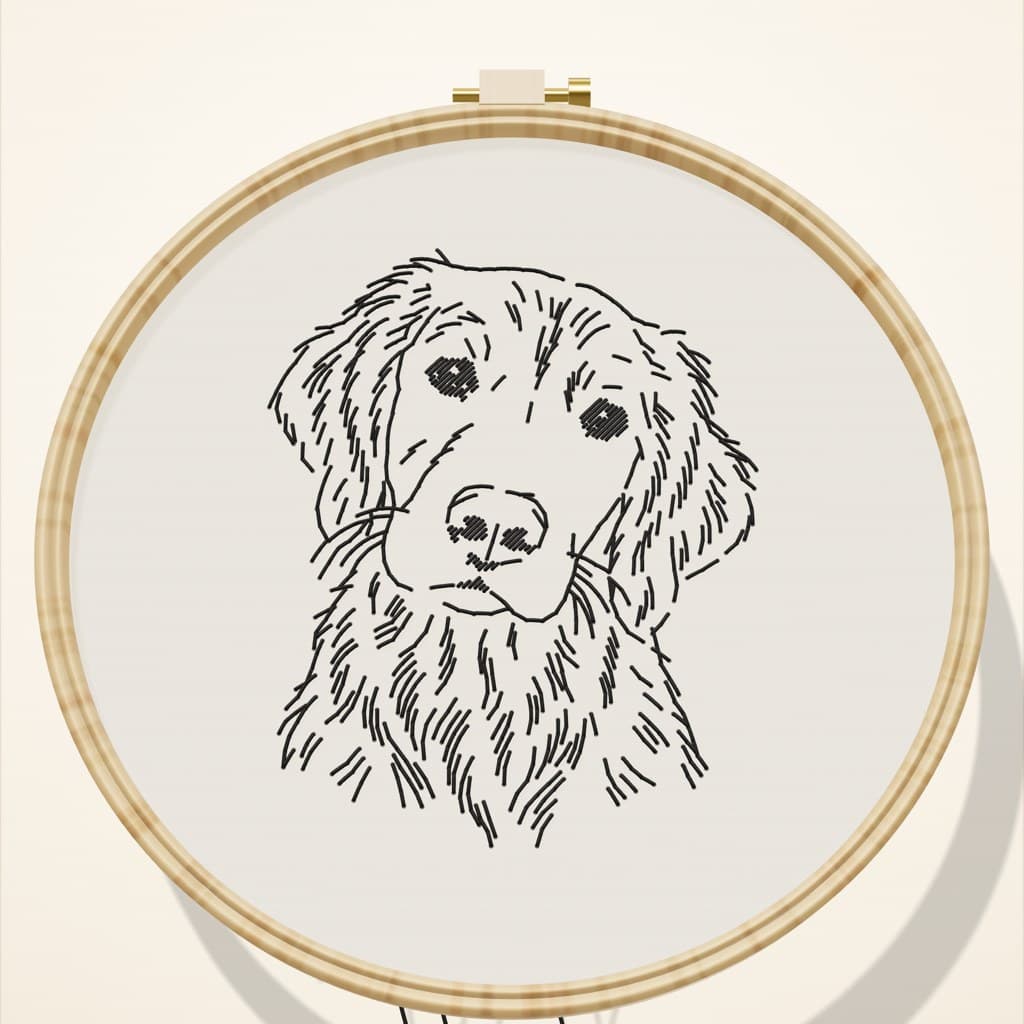
To embroider a black dog in black thread, don't fill the coat. Stitch only the edges: the outline against the background, the ear edges, the eye rims, the muzzle line and a few fur lines where light catches. Leave a bare highlight in each eye and on the nose. It all starts with a bright, evenly lit photo.
Why a black dog is tricky (it isn't the stitching)
In a photo, a black coat swallows its own edges. On a light dog, soft shadows show the shape of the cheek, the fold of the ear and the line of the jaw. On a black dog, all of that melts into one dark shape. In dim light it gets worse: a phone brightens a dark scene by smoothing it, and the fine edges you need are the first thing to go.
The thread doesn't care what color the dog is. In black line art on oatmeal linen, you draw with lines, not color, so a black Lab and a yellow Lab are stitched with the same kind of lines. What decides the portrait is whether you can see those lines in the photo. Get the photo right and a black dog is no harder to stitch than any other.
Our pattern maker runs into the same wall. It turns away photos that are mostly dark, and a dark coat in a dim photo can come out as solid black blobs. Those fail its line-art check, because a solid blob is miserable to stitch. A brighter photo usually fixes both problems. The Great Dane page gives black and blue Danes the same advice.
Take a photo that shows the edges
- Bright but soft light. Go outside on a bright, overcast day, or into open shade, like the shady side of the house on a sunny afternoon. The light is strong enough to reach into black fur without hard shadows.
- Or a big window. Put your dog facing the window and stand with your back to it, so the light falls on the face.
- Nothing bright behind them. A window, the sky or a lamp behind a black dog turns them into a silhouette. A pale wall or a light blanket behind them is ideal: the outline stands out against it. It keeps a boxer's black mask from vanishing, too.
- No flash. Flash flattens black fur into one shiny sheet and puts a hard glare in the eyes.
- Eye level, and a burst. Get down to their height and take a run of shots. Keep the one where both eyes catch a small point of light.
- Lift the shadows a little. In your phone's photo editor, nudge Shadows or Brightness up until you can see the edge of each ear and the line of the muzzle. Stop before the fur turns grey and grainy, and keep the original too.
The rest of the photo rules are the same for every dog: one dog, the face toward the camera, both eyes sharp, the original file rather than a screenshot. They're all in how to choose a photo.
What to stitch on a black dog
- The silhouette. The outline of the head, ears and shoulders against the background is most of the likeness. On a black dog it's the clearest line in the photo, so trust it.
- The ear edges. A black ear often lies against a black head with no line between them. Look for the thin rim of light along the ear's edge and stitch that rim.
- The eye rims and the catchlight. Dark brown eyes in dark fur can disappear. Back stitch the shape of each eye, fill the pupil with satin stitch, and leave the catchlight bare: the tiny reflection of the sky or the window. On a black dog, that bare spot is what makes the portrait look alive.
- The nose shine. Fill the nose with satin stitch and leave its small shiny spots as bare linen, the same as on any dog.
- The muzzle and mouth. The line where the muzzle meets the cheek, and the corner of the mouth. These carry the expression.
- A few fur lines where the light catches. Wherever the photo shows a gleam, on the top of the head, the cheek or the chest, a short fur line can go there. Nowhere else.
Free · 3D Stitch Simulator
Try satin stitch on a 3D hoop
Watch the first stitches, then tap where your needle goes. Turn the hoop, zoom in, and flip it over to check the back.
Practice the pupil and its bare highlight on the 3D hoop. On a black dog, the highlight is the detail that matters most.
Stitching it, step by step
- Outline first. Start at the top of the head and back stitch around the silhouette, ears included. It's your warm-up, and it fixes the shape.
- Then the ear rims. Stitch the light edge you found on each ear. If an ear and the head share an edge, one line does for both.
- Eyes, slowly. Back stitch the eye shapes, then fill the pupils in satin stitch, working from the middle out and stopping at the highlight. Do both eyes in one sitting so they match. More in how to embroider eyes.
- Nose and muzzle. Satin the nose around its shine, then stitch the muzzle line and the mouth.
- Fur lines last, and few. Add short lines only where the photo shows light on the coat, stitched from the root toward the tip.
- Squint from across the room. Prop the hoop up and squint. If you can see the dog's expression, stop. On a black dog, fewer lines nearly always look more like them.
White blazes, grey muzzles and tan points
In line art, every color is just bare linen, so a white chest blaze looks the same as the black coat around it unless you mark where one stops and the other starts. Stitch that boundary with short, broken strokes that follow the way the fur lies, rather than one hard line. A broken edge reads as a change of color; a solid line reads as a fold or a seam. The exception is a short, smooth coat with a crisp edge, like a boxer's mask: there the pattern may draw one clean line, and you stitch it as drawn.
The same trick works for the grey on an older dog's chin and for tan points on a black-and-tan dog: a few short strokes along the edge of the patch, and nothing inside it.
Should you fill a black dog in?
Three ways to stitch a black dog
| Approach | What you stitch | How it looks | Good to know |
|---|---|---|---|
| Black line art on light linen | The edges, the eyes, the nose and a few fur lines | An ink sketch of your dog | The course method: two stitches, a few evenings |
| A filled black coat | Solid black fill over the whole head | A heavy, flat dark shape | Many more hours, and big fills are hard to keep smooth and can pucker the linen |
| Light thread on dark fabric | The same lines in white or grey, on black or navy | A reversed sketch | Outside the course's black-on-oatmeal method, and the pattern has to show on dark fabric |
For a first portrait, stay with line art. If you love the reversed look, stick and stitch sheets work on dark fabric because the lines are printed on the sheet, not traced onto the cloth. Transferring to dark fabric covers the other options.
Questions people ask
How do you embroider a black dog on light fabric?
Stitch the edges in black thread, not the coat: the outline, the ear edges, the eye rims, the muzzle line and a few fur lines where light catches. Leave bare highlights in the eyes and on the nose.
How do you show the eyes on a black dog?
Back stitch the shape of each eye, fill the pupil with satin stitch, and leave the catchlight as bare linen. Pick a photo where both eyes reflect a small point of light.
Why was my black dog's photo turned away?
Our pattern maker turns away photos that are mostly dark, and a dark coat in dim light can come out as solid blobs that fail its line-art check. Try a photo taken in open shade or by a big window.
Should I fill in a black dog with black thread?
Not for a first portrait. A filled coat takes many more hours, is hard to keep smooth and can pucker the linen. Line art shows a black dog just as clearly.
Does a black Lab need a different pattern from a yellow Lab?
No. In black line art you stitch lines, not color, so both get the same kind of pattern. The only difference is how hard it is to see those lines in the photo.
Sources: Stitch Your Dog pattern maker: its photo checks and its real output on our sample dogs (1 Nov 2026) · Royal School of Needlework Stitch Bank: Back stitch · Needle 'n Thread: 10 tips for a sensational satin stitch