Dog breed
English bulldog embroidery pattern: stitch your own bulldog from a photo
To embroider an English bulldog, back stitch the wide, square head and the small rose ears, then the hanging jowls and the underbite, which give the likeness. Keep only the three or four deepest wrinkles, and satin stitch the eyes and nose. Use 2 strands of black floss on oatmeal linen in a 6-inch hoop.
- Coat Short: red, white, fawn or fallow, often brindle or piebald
- Ears Small, thin rose ears
- Look for Heavy wrinkles, undershot jaw, wide jowls
- Line-art fit great
The real pattern: Winston, our sample bulldog
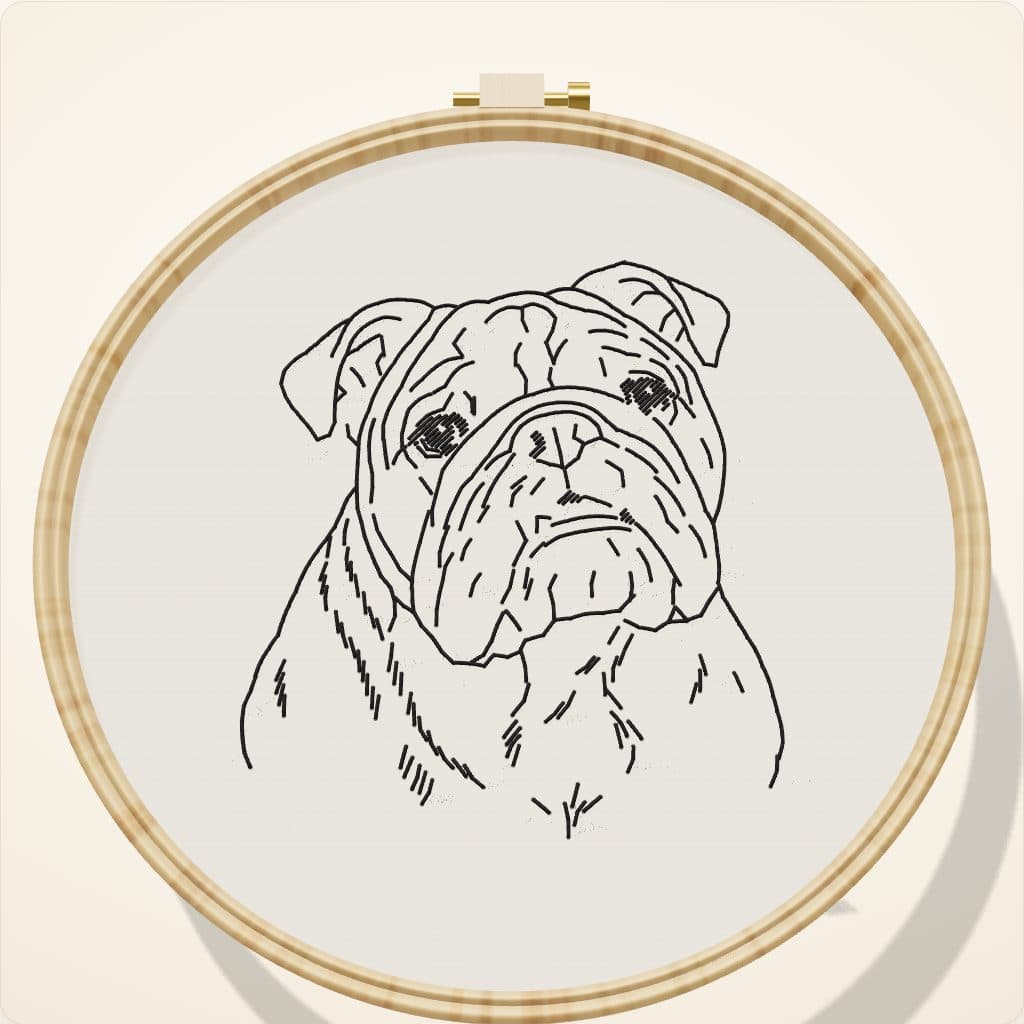
Our pattern maker made this from a photo of Winston, a fawn-and-white English bulldog and one of the sample dogs we use to test it. The photo is an AI-made sample image. The drawing, the dots and the stitched preview are the pattern maker's real output.
 1 The photoA sample photo (AI-made)
 2 The drawingClean line art, made by the pattern maker
- 3 The patternA dot at every needle hole, about 1/8 inch apart
- 4 StitchedA preview drawn from the pattern, in a 6-inch hoop
- Back stitches
- 557
- Satin fills
- 5 (eyes, nose and any small dark marks)
- Design size
- 4.0 × 4.6 in
- Thread
- 2 strands of black
- Rough stitching time
- 2½–4½ hours
Winston's pattern has more wrinkle lines than you'll want to stitch, because a bulldog's face really is that folded. That's normal. Stitch the outline, the jowls and the deepest folds first, then decide which of the rest to keep.
What makes a bulldog look like a bulldog in thread
The Bulldog standard (the AKC's name for the English bulldog) asks for a head covered with heavy wrinkles, small rose ears that fold back to show part of the inside, and massive, undershot jaws, the lower one jutting out and turning up. In line art three things give it away: the wide, square outline, the jowls and the underbite.
- Three or four wrinkles do it. Stitch the deepest fold over the nose and the deepest ones on the forehead. Every extra wrinkle makes the face older and busier.
- The jowls hang. The line of the lips drops down on either side of the jaw. Stitch it slowly, dot to dot. It's the bulldog's frown.
- The underbite turns up. The lower jaw sits in front of the upper one. A short curved line, and a few small teeth if your pattern shows them, is enough.
- Rose ears are small. Back stitch the little folded outline and one line for the fold. They sit high and wide on the head.
Brindle stripes don't stitch well in one color. Leave them out. The wrinkles and jowls carry a brindle bulldog just as well.
Getting a good photo of your bulldog
- Get even light on the whole face. Deep folds throw shadows, and shadows turn into extra lines.
- Shoot straight on, at eye level. From above, the jowls and the underbite disappear.
- Wait until the mouth is closed or nearly closed. A panting tongue hides the underbite.
- Brindle or dark coats: shoot by a big window or outdoors in open shade, so the folds still show.
Stitching order for an English bulldog
- The outline. Back stitch the wide outline of the head and the two rose ears.
- Jowls and jaw. Stitch the line of the lips and the jowls, then the underbite.
- The deepest wrinkles. Add the fold over the nose and the deepest wrinkles on the forehead.
- Eyes and nose. Satin stitch the pupils from the middle out with the highlight left bare, then fill the nose.
- Decide on the rest. Look at the hoop from across the room. Add more wrinkle lines only if the face still looks flat.
Giving it to a bulldog lover? A short name can sit in the narrow band under the jowls. Personalized dog gifts shows how to fit the words in a 6-inch hoop.
Common bulldog mistakes
- The face looks crumpled.
- Too many wrinkles. Pick the extras out from the back and keep the deepest three or four.
- It looks like a pug.
- The jowls are missing or cut short. Stitch the lip line all the way down past the jaw on both sides.
- The ears look like horns.
- Rose ears fold back and down. Follow the dots around the fold instead of cutting straight to the tip.
Questions people ask
Can I turn a photo of my Bulldog into an embroidery pattern?
Yes. The Stitch Your Dog course turns a photo of your own bulldog into a pattern with a dot at every stitch, the way it made Winston's here. Even light on the face matters most, because deep folds throw shadows.
What stitches work best for a Bulldog?
Back stitch for the outline, the ears, the wrinkles and the jowls, and satin stitch for the eyes and nose. Both are beginner stitches, and they're the two the course teaches.
How do I show a Bulldog's wrinkles in thread?
Choose the three or four deepest folds, usually the one across the nose and a couple on the forehead, and back stitch them as smooth curves. Leave the rest out. Fewer wrinkles look softer, and the wide outline and jowls already say bulldog.
How long does a Bulldog portrait take to stitch?
Winston's pattern has 647 stitches in all: 557 backstitches and 90 small satin stitches. At an easy beginner pace of 2.5 to 4 stitches a minute, that's roughly 2.5 to 4.5 hours, and less if you skip some wrinkles.
How is stitching an English bulldog different from a French bulldog?
Mostly the ears. A French bulldog has big, upright bat ears, and an English bulldog has small rose ears that fold back. The English bulldog also has heavier wrinkles and hanging jowls, so it takes more face lines.
Sources: Stitch Your Dog pattern maker: its photo checks and its real output on our sample dogs (1 Nov 2026) · American Kennel Club: the official Bulldog breed standard · Royal School of Needlework Stitch Bank: Back stitch · Royal School of Needlework Stitch Bank: Satin stitch