Comparison
Back stitch vs stem stitch vs split stitch: which outline should you use?
For a beginner's dog portrait, use back stitch. It makes a solid, even line, and each stitch goes from one dot to the next, so it's the easiest to keep neat. Stem stitch makes a smoother, rope-like line on curves such as ears. Split stitch gives a soft, fine line and a crisp edge under satin.
The three outline stitches at a glance
Back stitch, stem stitch and split stitch compared
| Back stitch | Stem stitch | Split stitch | |
|---|---|---|---|
| Looks like | A solid line of short, even stitches | A smooth, twisted rope | A fine line like a tiny chain |
| How it's made | Each stitch goes back into the end of the last one, sharing its hole | Each stitch comes up halfway along the last one, beside it, always on the same side | Each stitch comes up through the middle of the last one, splitting its strands |
| Curves | Good, with short stitches | Smoothest, with shorter stitches on tight curves | Good; it bends easily |
| Lettering | Clean and easy to read | Lovely on flowing script | Good for fine script |
| Thread | About the same for all three | About the same | About the same |
| For a beginner | Easiest: one dot to the next | Takes a little practice to keep the thread on one side | Easy, as long as the needle lands in the middle |
| The back | Longer stitches that overlap, much like stem stitch | A neat line that looks like back stitch | A neat line of short stitches |
So what's the best outline stitch? There's no single best for every job, but there is a best first one: back stitch. It's solid, it's even, and it's the hardest to get wrong. Learn it first, then add stem stitch and split stitch when a line calls for them.
Why our patterns use back stitch
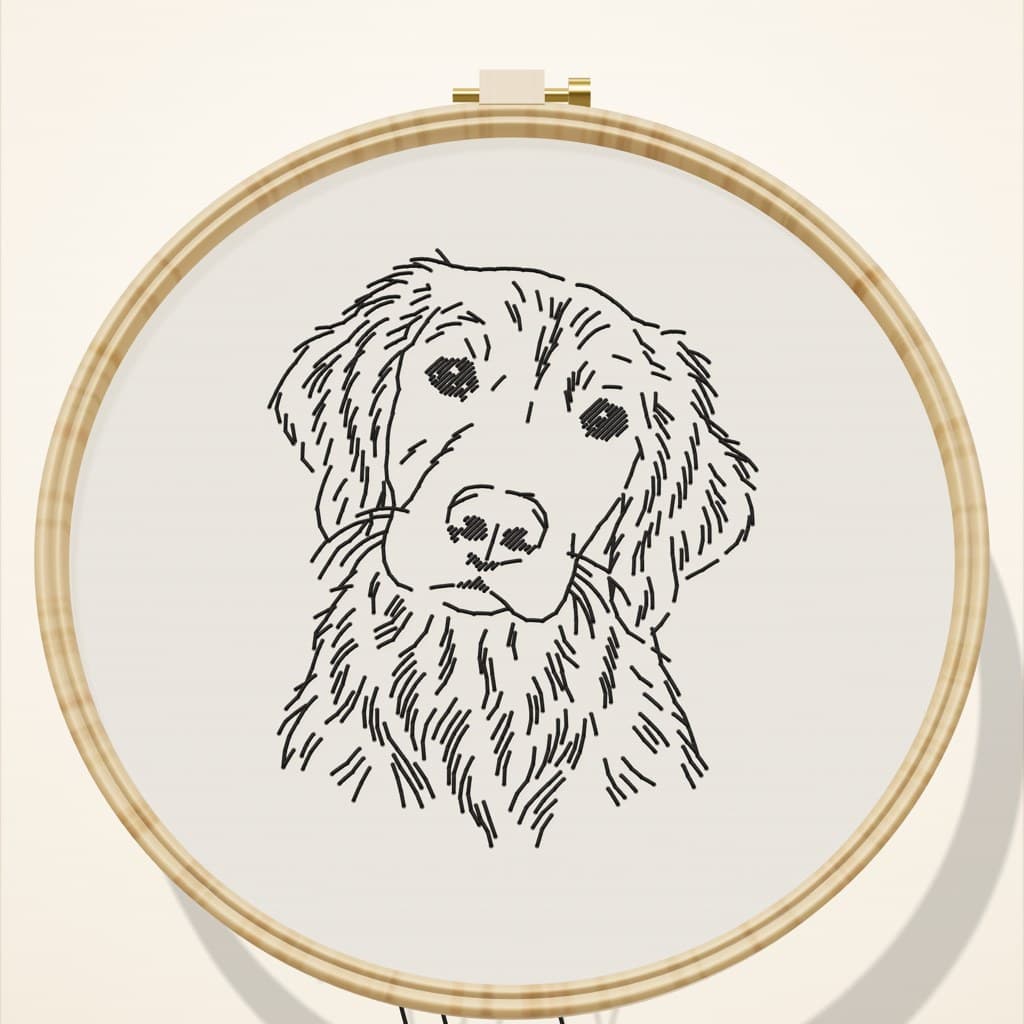
On a Stitch Your Dog pattern, every dot is one needle hole, about 1/8 inch from the next. Back stitch goes from dot to dot: up one dot ahead, down into the hole behind. Because each stitch shares its hole with the last, the line looks solid, and because the dots are evenly spaced, every stitch comes out the same length. That evenness is most of what makes a beginner's portrait look tidy.
Short, even stitches also follow curves well. An ear tip or the line of a chin is just more dots, closer together around the bend.
Free · 3D Stitch Simulator
Try back stitch on a 3D hoop
Watch the first stitches, then tap where your needle goes. Turn the hoop, zoom in, and flip it over to check the back.
Flip the hoop to see the back: those longer, overlapping stitches are exactly right.
When stem stitch or split stitch looks better
- Stem stitch on long, smooth curves. A floppy ear or the sweep of a back looks lovely in stem stitch. Keep the thread on the same side of the line the whole way, turn the hoop as you go, and make the stitches a little shorter where the curve tightens.
- Split stitch for soft edges. On a fluffy breed, a split-stitch outline looks gentler than back stitch.
- Split stitch under satin. A tiny split-stitch outline around an eye or the nose gives satin stitch a crisp edge to sit against. It's optional: plain satin works fine.
- Lettering: back stitch for a clean, printed name; stem stitch for flowing script.
You can mix them in one portrait. Back stitch for the outline and face, stem stitch on a long curved ear if you like the look, and split stitch only where you want a softer line. Keep the same 2 strands of black throughout, and the stitches will sit together naturally.
Questions people ask
Which is easier, back stitch or stem stitch?
Back stitch. Each stitch simply goes back into the hole where the last one ended. Stem stitch isn't hard, but you have to keep the thread on the same side of the needle every time, or the twist changes direction.
Which looks better for curves?
Stem stitch makes the smoothest curves. Back stitch handles curves well too if you keep the stitches short, which is why our patterns place a dot about every 1/8 inch.
Which is better for lettering?
Back stitch for clean, easy-to-read names. Stem stitch for flowing script, where its rope-like twist suits the curves.
Is split stitch or back stitch better for pet portraits?
Back stitch for the outline and face lines, because it gives a solid, even line from dot to dot. Split stitch is useful as a soft outline on a fluffy dog, and as an edge under satin-stitched eyes.
Which uses more thread?
There's little difference. All three cover the line once on the front and travel back along it underneath, so a line costs about the same thread whichever you choose. Very short stitches on tight curves use a little more.
What is the best outline stitch?
For beginners, back stitch: it's solid, even and easy to keep neat. Stem stitch is the favorite for smooth curves, and split stitch for fine, soft lines.
Sources: Royal School of Needlework Stitch Bank: Back stitch · Royal School of Needlework Stitch Bank: Stem stitch · Royal School of Needlework Stitch Bank: Split stitch · Needle 'n Thread: Stem stitch on tight curves