
Stitch guide · Outlines
How to do a running stitch
Running stitch is the simplest hand embroidery stitch: the needle goes up and down along a line, leaving even gaps, so it looks like a dashed line. Use it for light outlines, borders and decorative details. The back looks almost the same as the front, with dashes where the gaps are.
- Level Beginner
- Practice Free in the 3D simulator
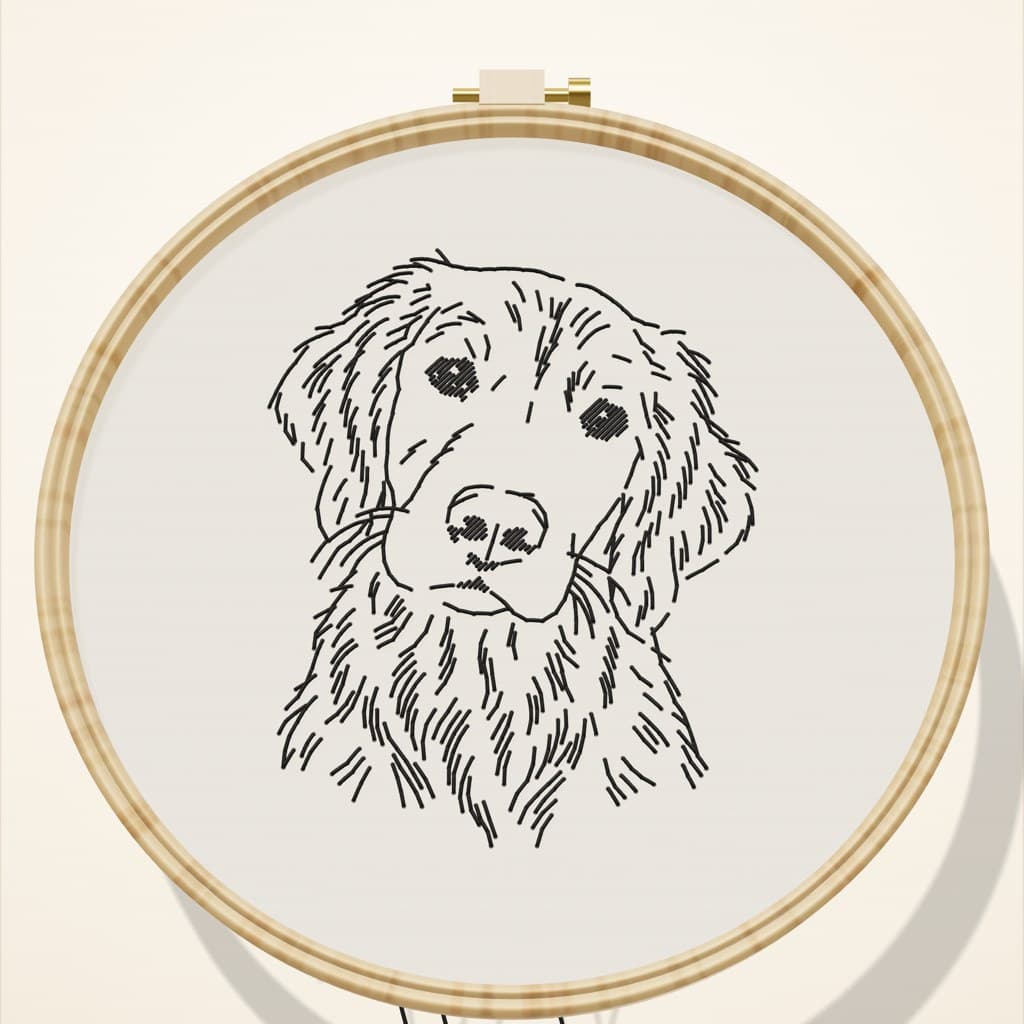
Use it in a pet portrait for…
- A dashed border around the hoop, like a little frame.
- Playful details: the dashes on a bandana, a ball's seam, or motion lines for a wagging tail.
- Finishing the hoop: a loose running stitch around the extra fabric on the back gathers it in like a drawstring.
For the main lines of a portrait, use back stitch instead. It looks solid, and running stitch is meant to show its gaps.
How to do it, step by step
Come up at 1 and go down at 2. Skip a small gap, come up at 3 and go down at 4. The dashed stitch, 5 to 6, is next.
1 Odd numbers: come up from the back2 Even numbers: go down Dashed: the next stitch
- Come up at the start of your line.
- Go down one stitch length along the line.
- Skip a small gap, then come up again.
- Go down one stitch length further on.
- Keep going. In a tight hoop, make one stitch at a time: up, then down.
- Keep the stitches the same length and the gaps the same size, then finish on the back under a few stitches.
Free · 3D Stitch Simulator
Try running stitch on a 3D hoop
Watch the first stitches, then tap where your needle goes. Turn the hoop, zoom in, and flip it over to check the back.
Common mistakes and how to fix them
- Uneven gaps.
- Pick a rhythm, such as a stitch and a slightly shorter gap, and repeat it. Even spacing matters more than perfect stitches.
- Puckered fabric.
- Don't pull the thread tight. It should lie flat on the fabric.
- Curves look choppy.
- Make shorter stitches and shorter gaps around curves.
How many strands?
Two strands for a delicate dashed line, or three if you want it to stand out from across the room.
Embroidery floss comes as six thin strands twisted together. Cut a length from your fingertips to your elbow, pull out the strands you need one at a time, and lay them back together (DMC’s guide to stranded floss).
Questions people ask
What's the difference between running stitch and back stitch?
Running stitch leaves gaps between stitches. Back stitch goes back to fill each gap, so the line is solid.
Can I load several running stitches on the needle at once?
On loose fabric, yes: weave the needle in and out a few times, then pull through. In a drum-tight hoop that's hard, so stab one stitch at a time instead.
What does the back of running stitch look like?
Almost the same as the front: a row of dashes, sitting where the gaps are on the front.
How long should running stitches be?
Whatever looks good to you, as long as they're even. Many stitchers make the gap a little shorter than the stitch.
Sources: Royal School of Needlework Stitch Bank: Running stitch · Needle 'n Thread: Sewing vs. stabbing