
Dog breed
German shorthaired pointer embroidery pattern: stitch your own GSP from a photo
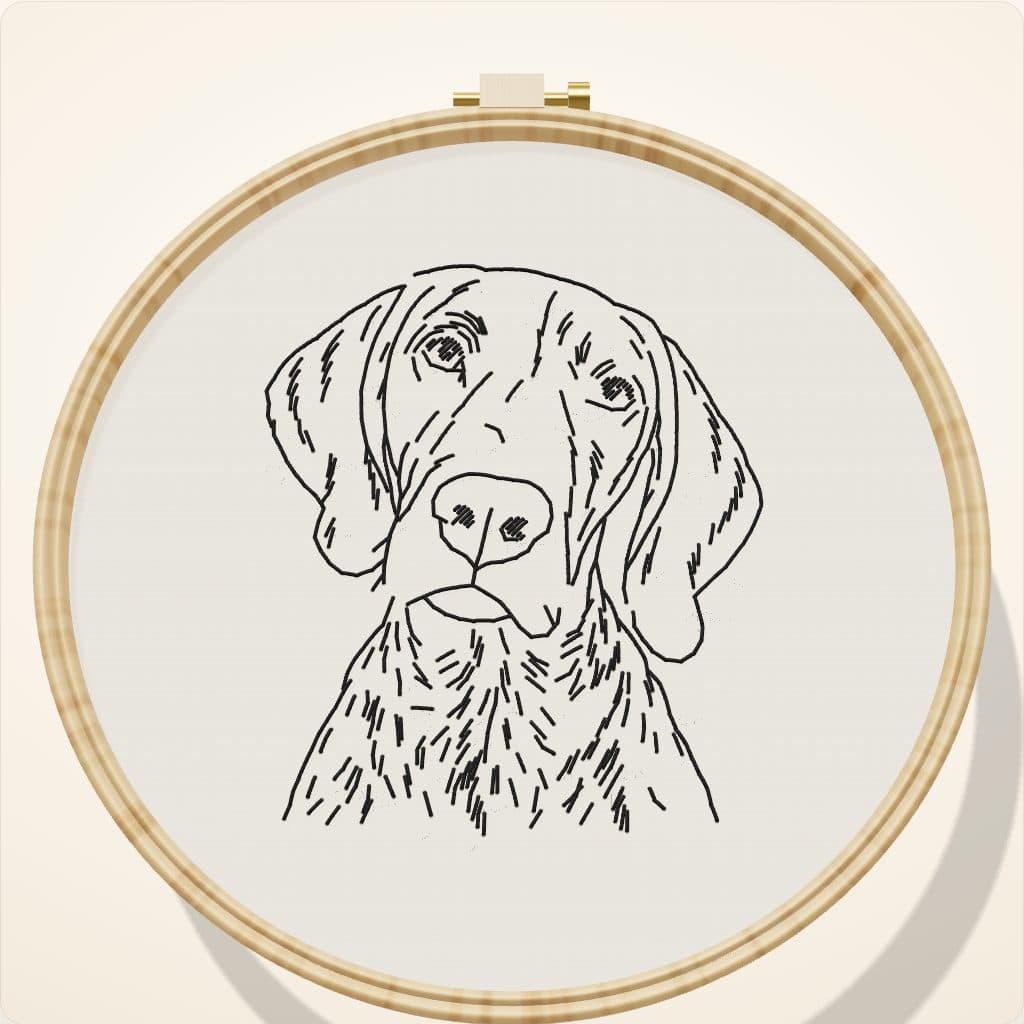
To embroider a German shorthaired pointer, back stitch the lean head and the broad drop ears first, then satin stitch the eyes and the big nose. Suggest the ticked coat with short strokes on the chest instead of a dot for every fleck. A head-and-chest portrait keeps it simple. Use 2 strands of black floss on oatmeal linen.
- Coat Short: liver, or liver and white, ticked, patched or roan
- Ears Broad drop ears that lie flat
- Look for Lean liver head, big nose, ticked coat
- Line-art fit good
The real pattern: Remi, our sample GSP
Our pattern maker made this from a photo of Remi, a liver-and-white German shorthaired pointer and one of the sample dogs we use to test it. The photo is an AI-made sample image. Everything after it is the pattern maker's real output.
 1 The photoA sample photo (AI-made)
 2 The drawingClean line art, made by the pattern maker
- 3 The patternA dot at every needle hole, about 1/8 inch apart
- 4 StitchedA preview drawn from the pattern, in a 6-inch hoop
- Back stitches
- 621
- Satin fills
- 4 (eyes, nose and any small dark marks)
- Design size
- 3.8 × 4.5 in
- Thread
- 2 strands of black
- Rough stitching time
- 3–4½ hours
Remi's head is solid liver, so it's drawn almost bare: a clean outline, the ears, the eyes and the long nose. The stitches go into the ticked chest, as rows of short strokes that suggest the flecks without copying them.
What makes a GSP look like a GSP in thread
The standard describes broad ears that lie flat and reach about to the corner of the mouth, almond-shaped eyes, and a large nose with broad, open nostrils. The coat can be solid liver or liver and white, ticked, patched or roan, and there are black versions too. The ticking is what trips people up, and the fix is to suggest it.
- Head and chest is easier. A head-and-chest portrait keeps most of the ticking out of the hoop. A 3-inch ornament keeps just the face, so the ticking drops out altogether.
- The ears are broad and flat. Stitch each one as a smooth outline that hangs to about the corner of the mouth. One fold line inside is plenty.
- The nose is big. Satin stitch around the nostrils and leave them bare. A big, open nose is part of the pointer look.
- Ticking is a few short strokes. Stitch short lines in loose rows on the chest, all following the coat. Want more texture afterwards? A few seed stitches add flecks. They're an extra, not part of the pattern.
GSP eyes are almond-shaped, not round. Keep the soft point at each corner of the eye outline, and satin stitch only the pupil.
Getting a good photo of your GSP
- Shoot in daylight with the light on the face. A solid liver head is dark, and in dim light its edges disappear.
- Get down to eye level so the long muzzle doesn't shrink.
- Keep both ears in the frame, down to the tips.
- Black or dark liver coats need your brightest photo: outdoors in open shade, or right by a big window. The pattern maker turns away photos that would come out as one dark shape.
More in how to choose a photo for a pet portrait and black and very dark dogs.
Stitching order for a German shorthaired pointer
- Head and ears. Back stitch the outline of the head, then each broad ear from the top of the head down.
- Face lines. Stitch the eye outlines, the long bridge of the nose and the mouth line.
- Eyes and nose. Satin stitch the pupils from the middle out with the highlight left bare, then fill the nose around the nostrils.
- The chest. Stitch the outline of the chest, then the rows of short ticking strokes, all going the same way.
- Stop early. Prop the hoop up across the room. If the chest already reads as ticked, leave the remaining strokes out.
Common GSP mistakes
- The chest looks like static.
- Too many ticking strokes, going every which way. Use fewer strokes in loose rows, all pointing the way the coat grows.
- The eyes look round and startled.
- The corners of the eye outline got rounded. Land on the corner dots so the almond shape stays.
- The ears stick out.
- The outline drifted away from the cheek. Follow the dots close to the face; GSP ears lie flat.
Questions people ask
Can I turn a photo of my German Shorthaired Pointer into an embroidery pattern?
Yes. The Stitch Your Dog course turns a photo of your own GSP into a pattern with a dot at every stitch, the way it made Remi's here. Use a daylight photo with the light on the face, so a dark liver head still shows its edges.
What stitches work best for a German Shorthaired Pointer?
Back stitch for the outline, the ears and the short ticking strokes, and satin stitch for the eyes and nose. Those are the two beginner stitches the course teaches. Seed stitch is an optional extra for more flecks.
How do I show a German Shorthaired Pointer's ticked coat in thread?
Suggest it. Stitch short strokes in loose rows on the chest, all following the direction of the coat, and leave plenty of bare linen between them. A dot for every fleck takes hours and turns into noise.
How long does a German Shorthaired Pointer portrait take to stitch?
Remi's pattern has 680 stitches in all: 621 backstitches and 59 small satin stitches. At an easy beginner pace of 2.5 to 4 stitches a minute, that's roughly 3 to 4.5 hours, over a few evenings.
Sources: Stitch Your Dog pattern maker: its photo checks and its real output on our sample dogs (1 Nov 2026) · American Kennel Club: the official German Shorthaired Pointer breed standard · Royal School of Needlework Stitch Bank: Back stitch · Royal School of Needlework Stitch Bank: Satin stitch