Comparison
Satin stitch vs long and short stitch: which fill should you use?
Use satin stitch for small shapes, like a dog's eyes and nose: straight stitches laid side by side, edge to edge. Switch to long and short stitch when a shape is too wide for one stitch to cross neatly, or when you want to blend colors. Long and short builds the fill in staggered rows instead.
Side by side
Satin stitch and long and short stitch compared
| Satin stitch | Long and short stitch | |
|---|---|---|
| Looks like | Smooth and solid, all one direction | Soft and painterly, with colors melting together |
| How it's made | Each stitch crosses the whole shape, edge to edge | Staggered rows, each row splitting into the one before |
| Shape size | Small | Medium to large |
| Colors | One per shape | Several shades, blended |
| The edge | Optional split-stitch outline | A split-stitch outline first |
| Strands | Two, or one for the smoothest finish | One for smooth blending |
| For a beginner | Easy | Takes practice |
| In a dog portrait | Eyes, nose, a collar tag | Realistic, shaded fur |
When to switch from satin to long and short
The limit is the length of a single stitch. Long satin stitches can sag, loosen and catch on things. Needle 'n Thread puts the longest sensible span at about an inch to an inch and a half, and that's with padding underneath. Without padding, keep satin stitches much shorter than that.
- The stitches move when you brush them with a finger. They're too long to stay put.
- The shape curves too much for stitches to stay parallel and neat.
- You want shading, from light to dark across the shape. Satin stitch is one color per shape.
Long and short isn't the only fix. You can split a wide shape into two halves and satin stitch each one, the way fishbone stitch fills a leaf. Or raise and firm it up with padded satin stitch.
Why a dog portrait's eyes and nose stay satin
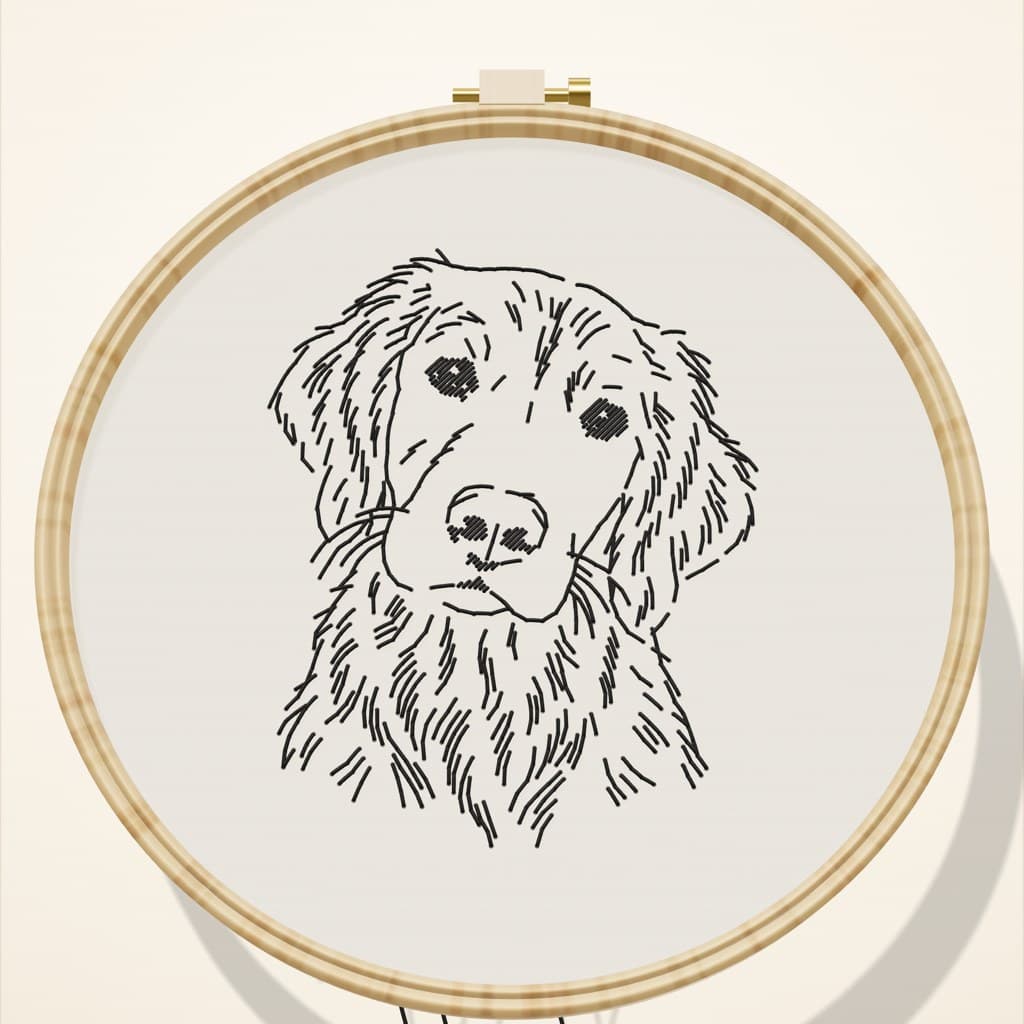
In a line portrait, the only filled shapes are small: the pupils and the nose. A single satin stitch crosses each of them easily, and with one color of black floss there's nothing to blend. That's why the Stitch Your Dog course teaches satin stitch, not long and short.
Satin also makes the eyes come alive. You stop the stitches at the edge of a tiny highlight, leave that spot of linen bare, and carry on past it. More in how to embroider eyes and how to embroider a dog's nose.
Free · 3D Stitch Simulator
Try satin stitch on a 3D hoop
Watch the first stitches, then tap where your needle goes. Turn the hoop, zoom in, and flip it over to check the back.
Fill a small shape, then flip the hoop: satin stitch covers the back almost the way it covers the front.
If you fall for realistic fur, long and short stitch is the next step. Start with one small patch, like an ear, with every row following the way the coat grows.
Common problems with each
- Satin stitches that sag or snag.
- The shape is too wide. Split it into sections, pad it, or switch to long and short stitch.
- Stripes in long and short stitch.
- Stagger where each stitch starts, so no two rows meet along a straight line.
- Satin stitches that drift to a slant.
- Start in the middle of the shape and work out to each side.
- Long and short stitches pointing every which way.
- Draw direction lines first, and make every stitch follow them.
Questions people ask
When should you switch from satin to long and short?
When a single satin stitch would be too long to lie flat and stay put, or when you want a shape shaded in more than one color. For small shapes like a dog's eyes and nose, plain satin is the better choice.
Is long and short stitch harder than satin stitch?
Yes. Each stitch is simple, but blending staggered rows smoothly takes practice. Satin stitch is one of the two stitches the Stitch Your Dog course teaches; long and short is a later step.
Is satin stitch the same as a fill stitch?
Satin stitch is one kind of fill stitch. A fill stitch is any stitch that covers an area instead of drawing a line, including long and short stitch, seed stitch and fishbone stitch.
How big can a satin stitch shape be?
Small. Needle 'n Thread suggests about an inch to an inch and a half as the very longest span, and that's worked over padding. For a beginner's unpadded satin, stay well under that.
Sources: Royal School of Needlework Stitch Bank: Satin stitch · Royal School of Needlework Stitch Bank: Long and short stitch · Needle 'n Thread: Some notes on satin stitch