
Comparison
Back stitch vs running stitch: what's the difference?
Running stitch goes up and down along a line and leaves even gaps, so it looks dashed. Back stitch goes backward into the end of the last stitch, filling each gap, so the line looks solid. For the outline of a dog portrait, use back stitch. Use running stitch for dashed borders and playful details.
Side by side
Back stitch and running stitch compared
| Back stitch | Running stitch | |
|---|---|---|
| Looks like | A solid, unbroken line | A dashed line with even gaps |
| How it's made | Come up one stitch ahead, then go back down into the end of the last stitch | Up, down, skip a gap, and repeat, always moving forward |
| The back | Longer stitches that overlap, about twice the length of the ones on the front | Almost the same as the front: dashes where the gaps are |
| Thread | More, because the back carries longer stitches | Less: roughly the length of the line |
| Strength | Firm: each stitch shares a hole with the next, which is why it's also a hand-sewn seam | Light: made for decoration, basting and gathering |
| Curves | Good, with short stitches | Good, with short stitches and short gaps |
| Best for | Outlines, faces and lettering | Borders, small details, and gathering the fabric on the back of a hoop |
Both are straight stitches worked along a line. The only real difference is what happens in the gap: running stitch leaves it, and back stitch goes back to fill it.
Why a portrait's lines are back stitch
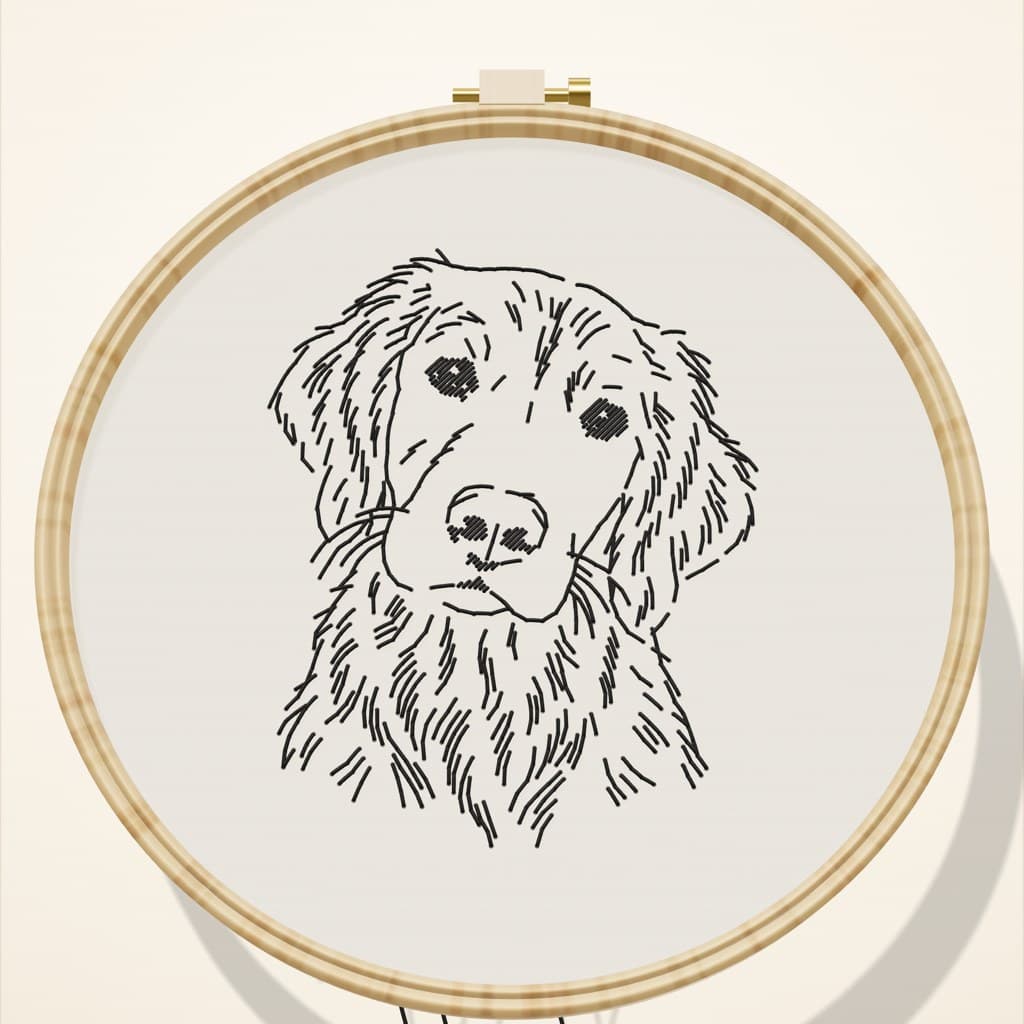
A face is made of a few lines in exactly the right places: the edge of an ear, the curve of the mouth, the line of the nose. If those lines break into dashes, the drawing starts to fall apart, especially from across the room. A solid line keeps the likeness.
That's why every line on a Stitch Your Dog pattern is back stitch. The dots are about 1/8 inch apart, and each stitch goes from one dot to the next, back into the hole the last stitch ended in. The line comes out solid and even without any measuring.
Free · 3D Stitch Simulator
Try running stitch on a 3D hoop
Watch the first stitches, then tap where your needle goes. Turn the hoop, zoom in, and flip it over to check the back.
Stitch a few running stitches, then try back stitch on the same hoop. Flip it over each time to compare the backs.
When running stitch is the right choice
- A dashed border around the hoop, like a little frame.
- Playful details: the dashes on a bandana, a ball's seam, or motion lines for a wagging tail.
- Finishing the hoop: a loose running stitch around the extra fabric on the back gathers it in like a drawstring. See how to frame embroidery in a hoop.
- A softer, lighter line where you want the fabric to show through.
Want a solid line that looks the same on both sides? Work running stitch along the line, then come back the other way, filling every gap through the same holes. That's double running stitch, also called Holbein stitch, a favorite in blackwork. It's tidy on the back, but it takes two passes and careful spacing, so for a first portrait, back stitch is simpler.
You can also wrap a second thread around a line of running stitch, the way you would for whipped back stitch, to turn the dashes into a smooth cord.
Common mix-ups and how to fix them
- Little gaps in a back stitch line.
- Go down into the exact hole the last stitch ended in, not just beside it.
- Running stitches that wander in size.
- Pick a rhythm, such as a stitch and a slightly shorter gap, and keep it all the way along.
- A face that looks broken.
- It was stitched in running stitch. Use back stitch for the outline and face lines, and save running stitch for borders.
- Shadows on the front of light linen.
- Either stitch can leave dark thread carried across the back. Slide under stitches you've made, or end off and restart, instead of jumping across bare fabric.
Questions people ask
Is back stitch stronger than running stitch?
Yes. Each back stitch shares a hole with the next, so the line is locked along its length. That's why back stitch is also used for strong hand-sewn seams, while running stitch is used for basting and gathering.
Which gives a solid line?
Back stitch. Running stitch always leaves gaps. To get a solid line from running stitch, you'd work back along it filling the gaps, which is called double running stitch.
Does back stitch use more thread?
Yes. On the back, each back stitch is about twice as long as it is on the front, so a line of back stitch uses more thread than the same line in running stitch.
Can I use both in one piece?
Yes. Back stitch for the dog and its name, running stitch for a dashed border around the hoop. Use the same 2 strands of black and they'll sit together nicely.
Sources: Royal School of Needlework Stitch Bank: Back stitch · Royal School of Needlework Stitch Bank: Running stitch · Royal School of Needlework Stitch Bank: Double running stitch